1
2
3
4
5
6
7
8
9
10
11
12
13
14
15
16
17
18
19
20
21
22
23
24
25
26
27
28
29
30
31
32
33
34
35
36
37
38
39
40
41
42
43
44
45
46
47
48
49
50
51
52
53
54
55
56
57
58
59
60
61
62
63
64
65
66
67
68
69
70
71
72
73
74
75
76
77
78
79
80
81
82
83
84
85
86
87
88
89
90
91
92
93
94
95
96
97
98
99
100
101
102
103
104
105
106
107
108
109
110
111
112
113
114
115
116
117
118
119
120
121
122
123
124
125
126
127
128
129
130
131
132
133
134
135
136
137
138
139
140
141
142
143
144
145
146
147
148
149
150
151
152
153
154
155
156
157
158
159
160
161
162
163
164
165
166
167
168
169
170
171
172
173
174
175
176
177
178
179
180
181
182
183
184
185
186
187
188
189
190
191
192
193
194
195
196
197
198
199
200
201
202
203
204
205
206
207
208
209
210
211
212
213
214
215
216
217
218
219
220
221
222
223
224
225
226
227
228
229
230
231
232
233
234
235
236
237
238
239
240
241
242
243
244
245
246
247
248
249
250
251
252
253
254
255
256
257
258
259
260
261
262
263
264
265
266
267
268
269
270
271
272
273
274
275
276
277
278
279
280
281
282
283
284
285
286
287
288
289
290
291
292
293
294
295
296
297
298
299
300
301
302
303
304
305
306
307
308
309
310
311
312
313
314
315
316
317
318
319
320
321
322
323
324
325
326
327
328
329
330
331
332
333
334
335
336
337
338
339
340
341
342
343
344
345
346
347
348
349
350
351
352
353
354
355
356
357
358
359
360
361
362
363
364
365
366
367
368
369
370
371
372
373
374
375
376
377
378
379
380
381
382
383
384
385
386
387
388
389
390
391
392
393
394
395
396
397
398
399
400
401
402
403
404
405
406
407
408
409
410
411
412
413
414
415
416
417
418
419
420
421
422
423
424
425
426
427
428
429
430
431
432
433
434
435
436
437
438
439
440
441
442
443
444
445
446
447
448
449
450
451
452
453
454
455
456
457
458
459
460
461
462
463
464
465
466
467
468
469
470
471
472
473
474
475
476
477
478
479
480
481
482
483
484
485
486
487
488
489
490
491
492
493
494
495
496
497
498
499
500
501
502
503
504
505
506
507
508
509
510
511
512
513
514
515
516
517
518
519
520
521
522
523
524
525
526
527
528
529
530
531
532
533
534
535
536
537
538
539
540
541
542
543
544
545
546
547
548
549
550
551
552
553
554
555
556
557
558
559
560
561
562
563
564
565
566
567
568
569
570
571
572
573
574
575
576
577
578
579
580
581
582
583
584
585
586
587
588
589
590
591
592
593
594
595
596
597
598
599
600
601
602
603
604
605
606
607
608
609
610
611
612
613
614
615
616
617
618
619
620
621
622
623
624
625
626
627
628
629
630
631
632
633
634
635
636
637
638
639
640
641
642
643
644
645
646
647
648
649
650
651
652
653
654
655
656
657
658
659
660
661
662
663
664
665
666
667
668
669
670
671
672
673
674
675
676
677
678
679
680
681
682
683
684
685
686
687
688
689
690
691
692
693
694
695
696
697
698
699
700
701
702
703
704
705
706
707
708
709
710
711
712
713
714
715
716
717
718
719
720
721
722
723
724
725
726
727
728
729
730
731
732
733
734
735
736
737
738
739
740
741
742
743
744
745
746
747
748
749
750
751
752
753
754
755
756
757
758
759
760
761
762
763
764
765
766
767
768
769
770
771
772
773
774
775
776
777
778
779
780
781
782
783
784
785
786
787
788
789
790
791
792
793
794
795
796
797
798
799
800
801
802
803
804
805
806
807
808
809
810
811
812
813
814
815
816
817
818
819
820
821
822
823
824
825
826
827
828
829
830
831
832
833
834
835
836
837
838
839
840
841
842
843
844
845
846
847
848
849
850
851
852
853
854
855
856
857
858
859
860
861
862
863
864
865
866
867
868
869
870
871
872
873
874
875
876
877
878
879
880
881
882
883
884
885
886
887
888
889
890
891
892
893
894
895
896
897
898
899
900
901
902
903
904
905
906
907
908
909
910
911
912
913
914
915
916
917
918
919
920
921
922
923
924
925
926
927
928
929
930
931
932
933
934
935
936
937
938
939
940
941
942
943
944
945
946
947
948
949
950
951
952
953
954
955
956
957
958
959
960
961
962
963
964
965
966
967
968
969
970
971
972
973
974
975
976
977
978
979
980
981
982
983
984
985
986
987
988
989
990
991
992
993
994
995
996
997
998
999
1000
1001
1002
1003
1004
1005
1006
1007
1008
1009
1010
1011
1012
1013
1014
1015
1016
1017
1018
1019
1020
1021
1022
1023
1024
1025
1026
1027
1028
1029
1030
1031
1032
1033
1034
1035
1036
1037
1038
1039
1040
1041
1042
1043
1044
1045
1046
1047
1048
1049
1050
1051
1052
1053
1054
1055
1056
1057
1058
1059
1060
1061
1062
1063
1064
1065
1066
1067
1068
1069
1070
1071
1072
1073
1074
1075
1076
1077
1078
1079
1080
1081
1082
1083
1084
1085
1086
1087
1088
1089
1090
1091
1092
1093
1094
1095
1096
1097
1098
1099
1100
1101
1102
1103
1104
1105
1106
1107
1108
1109
1110
1111
1112
1113
1114
1115
1116
1117
1118
1119
1120
1121
1122
1123
1124
1125
1126
1127
1128
1129
1130
1131
1132
1133
1134
1135
1136
1137
1138
1139
1140
1141
1142
1143
1144
1145
1146
1147
1148
1149
1150
1151
1152
1153
1154
1155
1156
1157
1158
1159
1160
1161
1162
1163
1164
1165
1166
1167
1168
1169
1170
1171
1172
1173
1174
1175
1176
1177
1178
1179
1180
1181
1182
1183
1184
1185
1186
1187
1188
1189
1190
1191
1192
1193
1194
1195
1196
1197
1198
1199
1200
1201
1202
1203
1204
1205
1206
1207
1208
1209
1210
1211
1212
1213
1214
1215
1216
1217
1218
1219
1220
1221
1222
1223
1224
1225
1226
1227
1228
1229
1230
1231
1232
1233
1234
1235
1236
1237
1238
1239
1240
1241
1242
1243
1244
1245
1246
1247
1248
1249
1250
1251
1252
1253
1254
1255
1256
1257
1258
1259
1260
1261
1262
1263
1264
1265
1266
1267
1268
1269
1270
1271
1272
1273
1274
1275
1276
1277
1278
1279
1280
1281
1282
1283
1284
1285
1286
1287
1288
1289
1290
1291
1292
1293
1294
1295
1296
1297
1298
1299
1300
1301
1302
1303
1304
1305
1306
1307
1308
1309
1310
1311
1312
1313
1314
1315
1316
1317
1318
1319
1320
1321
1322
1323
1324
1325
1326
1327
1328
1329
1330
1331
1332
1333
1334
1335
1336
1337
1338
1339
1340
1341
1342
1343
1344
1345
1346
1347
1348
1349
1350
1351
1352
1353
1354
1355
1356
1357
1358
1359
1360
1361
1362
1363
1364
1365
1366
1367
1368
1369
1370
1371
1372
1373
1374
1375
1376
1377
1378
1379
1380
1381
1382
1383
1384
1385
1386
1387
1388
1389
1390
1391
1392
1393
1394
1395
1396
1397
1398
1399
1400
1401
1402
1403
1404
1405
1406
1407
1408
1409
1410
1411
1412
1413
1414
1415
1416
1417
1418
1419
1420
1421
1422
1423
1424
1425
1426
1427
1428
1429
1430
1431
1432
1433
1434
1435
1436
1437
1438
1439
1440
1441
1442
1443
1444
1445
1446
1447
1448
1449
1450
1451
1452
1453
1454
1455
1456
1457
1458
1459
1460
1461
1462
1463
1464
1465
1466
1467
1468
1469
1470
1471
1472
1473
1474
1475
1476
1477
1478
1479
|
[Jump to content](#bodyContent)
Main menu
Main menu
move to sidebar
hide
Navigation
- [Main page](/wiki/Main_Page "Visit the main page [z]")
- [Contents](/wiki/Wikipedia:Contents "Guides to browsing Wikipedia")
- [Current
events](/wiki/Portal:Current_events "Articles related to current events")
- [Random
article](/wiki/Special:Random "Visit a randomly selected article [x]")
- [About
Wikipedia](/wiki/Wikipedia:About "Learn about Wikipedia and how it works")
- [Contact
us](//en.wikipedia.org/wiki/Wikipedia:Contact_us "How to contact Wikipedia")
Contribute
- [Help](/wiki/Help:Contents "Guidance on how to use and edit Wikipedia")
- [Learn to
edit](/wiki/Help:Introduction "Learn how to edit Wikipedia")
- [Community
portal](/wiki/Wikipedia:Community_portal "The hub for editors")
- [Recent
changes](/wiki/Special:RecentChanges "A list of recent changes to Wikipedia [r]")
- [Upload
file](/wiki/Wikipedia:File_upload_wizard "Add images or other media for use on Wikipedia")
- [Special pages](/wiki/Special:SpecialPages)
[


](/wiki/Main_Page)
[ Search](/wiki/Special:Search "Search Wikipedia [f]")
Search
Appearance
- [Donate](https://donate.wikimedia.org/?wmf_source=donate&wmf_medium=sidebar&wmf_campaign=en.wikipedia.org&uselang=en)
- [Create
account](/w/index.php?title=Special:CreateAccount&returnto=Thumb "You are encouraged to create an account and log in; however, it is not mandatory")
- [Log
in](/w/index.php?title=Special:UserLogin&returnto=Thumb "You're encouraged to log in; however, it's not mandatory. [o]")
Personal tools
- [Donate](https://donate.wikimedia.org/?wmf_source=donate&wmf_medium=sidebar&wmf_campaign=en.wikipedia.org&uselang=en)
- [ Create
account](/w/index.php?title=Special:CreateAccount&returnto=Thumb "You are encouraged to create an account and log in; however, it is not mandatory")
- [ Log
in](/w/index.php?title=Special:UserLogin&returnto=Thumb "You're encouraged to log in; however, it's not mandatory. [o]")
Pages for logged out editors [learn more](/wiki/Help:Introduction)
- [Contributions](/wiki/Special:MyContributions "A list of edits made from this IP address [y]")
- [Talk](/wiki/Special:MyTalk "Discussion about edits from this IP address [n]")
## Contents
move to sidebar
hide
- [](#)
(Top)
- [](#Definition)
1 Definition
Toggle Definition subsection
- [](#Thumb_and_fingers)
1.1 Thumb and fingers
- [](#Opposition_and_apposition)
2 Opposition and apposition
Toggle Opposition and apposition subsection
- [](#Humans)
2.1 Humans
- [](#Other_primates)
2.2 Other primates
- [](#Other_placental_mammals)
2.3 Other placental mammals
- [](#Marsupials)
2.4 Marsupials
- [](#Reptiles)
2.5 Reptiles
- [](#Dinosaurs)
2.6 Dinosaurs
- [](#Birds)
2.6.1 Birds
- [](#Pterosaurs)
2.6.2 Pterosaurs
- [](#Amphibians)
2.7 Amphibians
- [](#Human_anatomy)
3 Human anatomy
Toggle Human anatomy subsection
- [](#Skeleton)
3.1 Skeleton
- [](#Muscles)
3.2 Muscles
- [](#Extrinsic)
3.2.1 Extrinsic
- [](#Intrinsic)
3.2.2 Intrinsic
- [](#Variations)
3.3 Variations
- [](#Grips)
3.4 Grips
- [](#Human_evolution)
4 Human evolution
- [](#See_also)
5 See also
- [](#Notes)
6 Notes
- [](#References)
7 References
- [](#External_links)
8 External links
Toggle the table of contents
# Thumb
103 languages
- [अंगिका](https://anp.wikipedia.org/wiki/%E0%A4%85%E0%A4%82%E0%A4%97%E0%A5%82%E0%A4%A0%E0%A4%BE "अंगूठा – Angika")
- [Ænglisc](https://ang.wikipedia.org/wiki/%C3%9E%C5%ABma "Þūma – Old English")
- [العربية](https://ar.wikipedia.org/wiki/%D8%A5%D8%A8%D9%87%D8%A7%D9%85 "إبهام – Arabic")
- [Aragonés](https://an.wikipedia.org/wiki/Pulgar "Pulgar – Aragonese")
- [ܐܪܡܝܐ](https://arc.wikipedia.org/wiki/%DC%9F%DC%AA%DC%AC%DC%90 "ܟܪܬܐ – Aramaic")
- [अवधी](https://awa.wikipedia.org/wiki/%E0%A4%85%E0%A4%99%E0%A5%81%E0%A4%A0%E0%A4%BE "अङुठा – Awadhi")
- [Azərbaycanca](https://az.wikipedia.org/wiki/Ba%C5%9F_barmaq "Baş barmaq – Azerbaijani")
- [Basa
Bali](https://ban.wikipedia.org/wiki/Inan_lima "Inan lima – Balinese")
- [বাংলা](https://bn.wikipedia.org/wiki/%E0%A6%AC%E0%A7%83%E0%A6%A6%E0%A7%8D%E0%A6%A7%E0%A6%BE%E0%A6%99%E0%A7%8D%E0%A6%97%E0%A7%81%E0%A6%B2%E0%A6%BF "বৃদ্ধাঙ্গুলি – Bangla")
- [閩南語 /
Bân-lâm-gú](https://zh-min-nan.wikipedia.org/wiki/T%C5%8Da-th%C3%A2u-b%C3%BA "Tōa-thâu-bú – Minnan")
- [Bikol
Central](https://bcl.wikipedia.org/wiki/Tangan "Tangan – Central Bikol")
- [Български](https://bg.wikipedia.org/wiki/%D0%9F%D0%B0%D0%BB%D0%B5%D1%86 "Палец – Bulgarian")
- [Boarisch](https://bar.wikipedia.org/wiki/Daam "Daam – Bavarian")
- [Bosanski](https://bs.wikipedia.org/wiki/Palac "Palac – Bosnian")
- [Brezhoneg](https://br.wikipedia.org/wiki/Meud "Meud – Breton")
- [Català](https://ca.wikipedia.org/wiki/Polze "Polze – Catalan")
- [Чӑвашла](https://cv.wikipedia.org/wiki/%D0%9F%D0%B0%D1%88-%D0%BF%D3%B3%D1%80%D0%BD%D0%B5 "Паш-пӳрне – Chuvash")
- [Čeština](https://cs.wikipedia.org/wiki/Palec "Palec – Czech")
- [Dansk](https://da.wikipedia.org/wiki/Tommelfinger "Tommelfinger – Danish")
- [Deitsch](https://pdc.wikipedia.org/wiki/Daume "Daume – Pennsylvania German")
- [Deutsch](https://de.wikipedia.org/wiki/Daumen "Daumen – German")
- [ދިވެހިބަސް](https://dv.wikipedia.org/wiki/%DE%84%DE%AE%DE%91%DE%AA%DE%88%DE%A6%DE%87%DE%A8_%DE%87%DE%A8%DE%82%DE%8E%DE%A8%DE%8D%DE%A8 "ބޮޑުވައި އިނގިލި – Divehi")
- [Eesti](https://et.wikipedia.org/wiki/P%C3%B6ial "Pöial – Estonian")
- [Ελληνικά](https://el.wikipedia.org/wiki/%CE%91%CE%BD%CF%84%CE%AF%CF%87%CE%B5%CE%B9%CF%81%CE%B1%CF%82 "Αντίχειρας – Greek")
- [Эрзянь](https://myv.wikipedia.org/wiki/%D0%9F%D0%B5%D0%BB%D1%8C%D0%BA%D0%B0 "Пелька – Erzya")
- [Español](https://es.wikipedia.org/wiki/Dedo_pulgar "Dedo pulgar – Spanish")
- [Esperanto](https://eo.wikipedia.org/wiki/Dikfingro "Dikfingro – Esperanto")
- [Euskara](https://eu.wikipedia.org/wiki/Erpuru "Erpuru – Basque")
- [فارسی](https://fa.wikipedia.org/wiki/%D8%B4%D8%B3%D8%AA "شست – Persian")
- [Français](https://fr.wikipedia.org/wiki/Pouce_(anatomie) "Pouce (anatomie) – French")
- [Frysk](https://fy.wikipedia.org/wiki/Tomme "Tomme – Western Frisian")
- [Gaeilge](https://ga.wikipedia.org/wiki/Ord%C3%B3g "Ordóg – Irish")
- [Gàidhlig](https://gd.wikipedia.org/wiki/%C3%92rdag "Òrdag – Scottish Gaelic")
- [Galego](https://gl.wikipedia.org/wiki/Polgar "Polgar – Galician")
- [ગુજરાતી](https://gu.wikipedia.org/wiki/%E0%AA%85%E0%AA%82%E0%AA%97%E0%AB%82%E0%AA%A0%E0%AB%8B "અંગૂઠો – Gujarati")
- [한국어](https://ko.wikipedia.org/wiki/%EC%97%84%EC%A7%80%EC%86%90%EA%B0%80%EB%9D%BD "엄지손가락 – Korean")
- [Հայերեն](https://hy.wikipedia.org/wiki/%D4%B2%D5%B8%D6%82%D5%A9_%D5%B4%D5%A1%D5%BF "Բութ մատ – Armenian")
- [हिन्दी](https://hi.wikipedia.org/wiki/%E0%A4%85%E0%A4%82%E0%A4%97%E0%A5%81%E0%A4%B7%E0%A5%8D%E0%A4%A0 "अंगुष्ठ – Hindi")
- [Hrvatski](https://hr.wikipedia.org/wiki/Palac "Palac – Croatian")
- [Ido](https://io.wikipedia.org/wiki/Polexo "Polexo – Ido")
- [Bahasa
Indonesia](https://id.wikipedia.org/wiki/Ibu_jari "Ibu jari – Indonesian")
- [Italiano](https://it.wikipedia.org/wiki/Pollice_(dito) "Pollice (dito) – Italian")
- [עברית](https://he.wikipedia.org/wiki/%D7%90%D7%92%D7%95%D7%93%D7%9C "אגודל – Hebrew")
- [Jawa](https://jv.wikipedia.org/wiki/Jempol "Jempol – Javanese")
- [ಕನ್ನಡ](https://kn.wikipedia.org/wiki/%E0%B2%B9%E0%B3%86%E0%B2%AC%E0%B3%8D%E0%B2%AC%E0%B3%86%E0%B2%B0%E0%B2%B3%E0%B3%81 "ಹೆಬ್ಬೆರಳು – Kannada")
- [Қазақша](https://kk.wikipedia.org/wiki/%D0%91%D0%B0%D1%80%D0%BC%D0%B0%D2%9B "Бармақ – Kazakh")
- [Kiswahili](https://sw.wikipedia.org/wiki/Kidole_gumba "Kidole gumba – Swahili")
- [Kreyòl
ayisyen](https://ht.wikipedia.org/wiki/Pous_(anatomi) "Pous (anatomi) – Haitian Creole")
- [Latina](https://la.wikipedia.org/wiki/Pollex_(anatomia) "Pollex (anatomia) – Latin")
- [Latviešu](https://lv.wikipedia.org/wiki/%C4%AAk%C5%A1%C4%B7is "Īkšķis – Latvian")
- [Ligure](https://lij.wikipedia.org/wiki/P%C5%93uxo_(dio) "Pœuxo (dio) – Ligurian")
- [Lombard](https://lmo.wikipedia.org/wiki/Mazza-pioeugg "Mazza-pioeugg – Lombard")
- [Македонски](https://mk.wikipedia.org/wiki/%D0%9F%D0%B0%D0%BB%D0%B5%D1%86 "Палец – Macedonian")
- [मराठी](https://mr.wikipedia.org/wiki/%E0%A4%85%E0%A4%82%E0%A4%97%E0%A4%A0%E0%A4%BE "अंगठा – Marathi")
- [Bahasa
Melayu](https://ms.wikipedia.org/wiki/Ibu_jari "Ibu jari – Malay")
- [閩東語 /
Mìng-dĕ̤ng-ngṳ̄](https://cdo.wikipedia.org/wiki/Du%C3%A2i-c%C4%81i "Duâi-cāi – Mindong")
- [မြန်မာဘာသာ](https://my.wikipedia.org/wiki/%E1%80%9C%E1%80%80%E1%80%BA%E1%80%99_(%E1%80%81%E1%80%94%E1%80%B9%E1%80%93%E1%80%AC%E1%80%97%E1%80%B1%E1%80%92) "လက်မ (ခန္ဓာဗေဒ) – Burmese")
- [Nederlands](https://nl.wikipedia.org/wiki/Duim_(vinger) "Duim (vinger) – Dutch")
- [नेपाली](https://ne.wikipedia.org/wiki/%E0%A4%AC%E0%A5%82%E0%A4%A2%E0%A5%80_%E0%A4%94%E0%A4%81%E0%A4%B2%E0%A4%BE "बूढी औँला – Nepali")
- [日本語](https://ja.wikipedia.org/wiki/%E8%A6%AA%E6%8C%87 "親指 – Japanese")
- [Norsk
bokmål](https://no.wikipedia.org/wiki/Tommel "Tommel – Norwegian Bokmål")
- [Norsk
nynorsk](https://nn.wikipedia.org/wiki/Tommelfinger "Tommelfinger – Norwegian Nynorsk")
- [Occitan](https://oc.wikipedia.org/wiki/Poce "Poce – Occitan")
- [ਪੰਜਾਬੀ](https://pa.wikipedia.org/wiki/%E0%A8%85%E0%A9%B0%E0%A8%97%E0%A9%82%E0%A8%A0%E0%A8%BE "ਅੰਗੂਠਾ – Punjabi")
- [Pangasinan](https://pag.wikipedia.org/wiki/Tangan "Tangan – Pangasinan")
- [پنجابی](https://pnb.wikipedia.org/wiki/%D8%A7%D9%86%DA%AF%D9%88%D9%B9%DA%BE%D8%A7 "انگوٹھا – Western Punjabi")
- [Plattdüütsch](https://nds.wikipedia.org/wiki/Dumen "Dumen – Low German")
- [Polski](https://pl.wikipedia.org/wiki/Kciuk "Kciuk – Polish")
- [Português](https://pt.wikipedia.org/wiki/Polegar "Polegar – Portuguese")
- [Ripoarisch](https://ksh.wikipedia.org/wiki/Dumm "Dumm – Colognian")
- [Română](https://ro.wikipedia.org/wiki/Deget_mare "Deget mare – Romanian")
- [Русский](https://ru.wikipedia.org/wiki/%D0%91%D0%BE%D0%BB%D1%8C%D1%88%D0%BE%D0%B9_%D0%BF%D0%B0%D0%BB%D0%B5%D1%86 "Большой палец – Russian")
- [संस्कृतम्](https://sa.wikipedia.org/wiki/%E0%A4%85%E0%A4%99%E0%A5%8D%E0%A4%97%E0%A5%81%E0%A4%B7%E0%A5%8D%E0%A4%A0%E0%A4%83 "अङ्गुष्ठः – Sanskrit")
- [ᱥᱟᱱᱛᱟᱲᱤ](https://sat.wikipedia.org/wiki/%E1%B1%A6%E1%B1%9F%E1%B1%B2%E1%B1%9F%E1%B1%A2_%E1%B1%A0%E1%B1%9F%E1%B1%B9%E1%B1%B4%E1%B1%A9%E1%B1%B5 "ᱦᱟᱲᱟᱢ ᱠᱟᱹᱴᱩᱵ – Santali")
- [Scots](https://sco.wikipedia.org/wiki/Thoum "Thoum – Scots")
- [Sicilianu](https://scn.wikipedia.org/wiki/Puseri "Puseri – Sicilian")
- [سنڌي](https://sd.wikipedia.org/wiki/%D8%A2%DA%B1%D9%88%D9%BA%D9%88 "آڱوٺو – Sindhi")
- [Slovenčina](https://sk.wikipedia.org/wiki/Palec_(prst) "Palec (prst) – Slovak")
- [Soomaaliga](https://so.wikipedia.org/wiki/Suul "Suul – Somali")
- [کوردی](https://ckb.wikipedia.org/wiki/%D8%A6%DB%95%D8%B3%D9%BE%DB%8E_%DA%A9%D9%88%DA%98%DB%95 "ئەسپێ کوژە – Central Kurdish")
- [Српски /
srpski](https://sr.wikipedia.org/wiki/%D0%9F%D0%B0%D0%BB%D0%B0%D1%86 "Палац – Serbian")
- [Srpskohrvatski /
српскохрватски](https://sh.wikipedia.org/wiki/Palac "Palac – Serbo-Croatian")
- [Sunda](https://su.wikipedia.org/wiki/Indung_leungeun "Indung leungeun – Sundanese")
- [Suomi](https://fi.wikipedia.org/wiki/Peukalo "Peukalo – Finnish")
- [Svenska](https://sv.wikipedia.org/wiki/Tumme "Tumme – Swedish")
- [Tagalog](https://tl.wikipedia.org/wiki/Hinlalaki "Hinlalaki – Tagalog")
- [தமிழ்](https://ta.wikipedia.org/wiki/%E0%AE%AA%E0%AF%86%E0%AE%B0%E0%AF%81_%E0%AE%B5%E0%AE%BF%E0%AE%B0%E0%AE%B2%E0%AF%8D "பெரு விரல் – Tamil")
- [తెలుగు](https://te.wikipedia.org/wiki/%E0%B0%AC%E0%B1%8A%E0%B0%9F%E0%B0%A8_%E0%B0%B5%E0%B1%87%E0%B0%B2%E0%B1%81 "బొటన వేలు – Telugu")
- [ไทย](https://th.wikipedia.org/wiki/%E0%B8%99%E0%B8%B4%E0%B9%89%E0%B8%A7%E0%B8%AB%E0%B8%B1%E0%B8%A7%E0%B9%81%E0%B8%A1%E0%B9%88%E0%B8%A1%E0%B8%B7%E0%B8%AD "นิ้วหัวแม่มือ – Thai")
- [Türkçe](https://tr.wikipedia.org/wiki/Ba%C5%9Fparmak "Başparmak – Turkish")
- [Tyap](https://kcg.wikipedia.org/wiki/A%CC%B1turugbak_mbwak "A̱turugbak mbwak – Tyap")
- [Українська](https://uk.wikipedia.org/wiki/%D0%92%D0%B5%D0%BB%D0%B8%D0%BA%D0%B8%D0%B9_%D0%BF%D0%B0%D0%BB%D0%B5%D1%86%D1%8C "Великий палець – Ukrainian")
- [اردو](https://ur.wikipedia.org/wiki/%D8%A7%D9%86%DA%AF%D9%88%D9%B9%DA%BE%D8%A7 "انگوٹھا – Urdu")
- [ئۇيغۇرچە /
Uyghurche](https://ug.wikipedia.org/wiki/%D8%A8%D8%A7%D8%B4_%D8%A8%D8%A7%D8%B1%D9%85%D8%A7%D9%82 "باش بارماق – Uyghur")
- [Tiếng
Việt](https://vi.wikipedia.org/wiki/Ng%C3%B3n_c%C3%A1i "Ngón cái – Vietnamese")
- [Võro](https://fiu-vro.wikipedia.org/wiki/P%C3%A4kk "Päkk – Võro")
- [Walon](https://wa.wikipedia.org/wiki/P%C3%B4ce "Pôce – Walloon")
- [Winaray](https://war.wikipedia.org/wiki/Tamuragk%C3%B4 "Tamuragkô – Waray")
- [吴语](https://wuu.wikipedia.org/wiki/%E6%8B%87%E6%8C%87 "拇指 – Wu")
- [Yorùbá](https://yo.wikipedia.org/wiki/%C3%80t%C3%A0np%C3%A0k%C3%B2 "Àtànpàkò – Yoruba")
- [粵語](https://zh-yue.wikipedia.org/wiki/%E6%89%8B%E6%8C%87%E5%85%AC "手指公 – Cantonese")
- [中文](https://zh.wikipedia.org/wiki/%E6%8B%87%E6%8C%87 "拇指 – Chinese")
- [Betawi](https://bew.wikipedia.org/wiki/Jempol "Jempol – Betawi")
[Edit
links](https://www.wikidata.org/wiki/Special:EntityPage/Q83360#sitelinks-wikipedia "Edit interlanguage links")
- [Article](/wiki/Thumb "View the content page [c]")
- [Talk](/wiki/Talk:Thumb "Discuss improvements to the content page [t]")
English
- [Read](/wiki/Thumb)
- [Edit](/w/index.php?title=Thumb&action=edit "Edit this page [e]")
- [View
history](/w/index.php?title=Thumb&action=history "Past revisions of this page [h]")
Tools
Tools
move to sidebar
hide
Actions
- [Read](/wiki/Thumb)
- [Edit](/w/index.php?title=Thumb&action=edit "Edit this page [e]")
- [View history](/w/index.php?title=Thumb&action=history)
General
- [What links
here](/wiki/Special:WhatLinksHere/Thumb "List of all English Wikipedia pages containing links to this page [j]")
- [Related
changes](/wiki/Special:RecentChangesLinked/Thumb "Recent changes in pages linked from this page [k]")
- [Upload
file](//en.wikipedia.org/wiki/Wikipedia:File_Upload_Wizard "Upload files [u]")
- [Permanent
link](/w/index.php?title=Thumb&oldid=1274819517 "Permanent link to this revision of this page")
- [Page
information](/w/index.php?title=Thumb&action=info "More information about this page")
- [Cite this
page](/w/index.php?title=Special:CiteThisPage&page=Thumb&id=1274819517&wpFormIdentifier=titleform "Information on how to cite this page")
- [Get shortened
URL](/w/index.php?title=Special:UrlShortener&url=https%3A%2F%2Fen.wikipedia.org%2Fwiki%2FThumb)
- [Download QR
code](/w/index.php?title=Special:QrCode&url=https%3A%2F%2Fen.wikipedia.org%2Fwiki%2FThumb)
Print/export
- [Download as
PDF](/w/index.php?title=Special:DownloadAsPdf&page=Thumb&action=show-download-screen "Download this page as a PDF file")
- [Printable
version](/w/index.php?title=Thumb&printable=yes "Printable version of this page [p]")
In other projects
- [Wikimedia
Commons](https://commons.wikimedia.org/wiki/Category:Thumbs)
- [Wikidata
item](https://www.wikidata.org/wiki/Special:EntityPage/Q83360 "Structured data on this page hosted by Wikidata [g]")
Appearance
move to sidebar
hide
From Wikipedia, the free encyclopedia
First digit of the hand
This article is about the digit of the hand. For other uses, see [Thumb
(disambiguation)](/wiki/Thumb_(disambiguation) "Thumb (disambiguation)").
[TABLE]
The **thumb** is the first
[digit](/wiki/Digit_(anatomy) "Digit (anatomy)") of the
[hand](/wiki/Hand "Hand"), next to the [index
finger](/wiki/Index_finger "Index finger").^([\[A\]](#cite_note-2)) When
a person is standing in the medical [anatomical
position](/wiki/Anatomical_position "Anatomical position") (where the
palm is facing to the front), the thumb is the outermost digit. The
Medical Latin English noun for thumb is
[*pollex*](https://en.wiktionary.org/wiki/pollex "wikt:pollex") (compare
[*hallux*](/wiki/Toe#Hallux "Toe") for big toe), and the corresponding
adjective for thumb is
[*pollical*](https://en.wiktionary.org/wiki/pollical "wikt:pollical").
## Definition
\[[edit](/w/index.php?title=Thumb&action=edit§ion=1 "Edit section: Definition")\]
[TABLE]
### Thumb and fingers
\[[edit](/w/index.php?title=Thumb&action=edit§ion=2 "Edit section: Thumb and fingers")\]
The English word *finger* has two
[senses](/wiki/Finger_numbering "Finger numbering"), even in the context
of appendages of a single typical human hand: 1) Any of the five
terminal members of the hand. 2) Any of the four terminal members of the
hand, other than the thumb.^([\[2\]](#cite_note-3))
Linguistically, it appears that the original sense was the first of
these two: \**penkwe-ros* (also rendered as \**penqrós*) was, in the
inferred [Proto-Indo-European
language](/wiki/Proto-Indo-European_language "Proto-Indo-European language"),
a suffixed form of \**penkwe* (or \**penqe*), which has given rise to
many
[Indo-European](/wiki/Indo-European_languages "Indo-European languages")-family
words (tens of them defined in English dictionaries) that involve, or
stem from, concepts of fiveness.
The thumb shares the following with each of the other four fingers:
- Having a skeleton of [phalanges](/wiki/Phalanges "Phalanges"),
joined by hinge-like joints that provide flexion toward the palm of
the hand
- Having a dorsal surface that features hair and a nail, and a
hairless palmar aspect with
[fingerprint](/wiki/Fingerprint "Fingerprint") ridges
The thumb contrasts with each of the other four fingers by being the
only one that:
- Is opposable to the other four fingers
- Has two [phalanges](/wiki/Phalanges "Phalanges") rather than three.
However, recently there have been reports that the thumb, like other
fingers, has three phalanges, but lacks a metacarpal
bone.^([\[3\]](#cite_note-4))
- Has greater breadth in the [distal](/wiki/Distal "Distal") phalanx
than in the [proximal](/wiki/Proximal "Proximal") phalanx
- Is attached to such a mobile
[metacarpus](/wiki/Metacarpus "Metacarpus") (which produces most of
the opposability)
- Curls horizontally instead of vertically
and hence the etymology of the word: \**tum* is Proto-Indo-European for
'swelling' (cf 'tumor' and 'thigh') since the thumb is the stoutest of
the fingers.
## Opposition and apposition
\[[edit](/w/index.php?title=Thumb&action=edit§ion=3 "Edit section: Opposition and apposition")\]
### Humans
\[[edit](/w/index.php?title=Thumb&action=edit§ion=4 "Edit section: Humans")\]
Anatomists and other researchers focused on human anatomy have hundreds
of definitions of *opposition*.^([\[4\]](#cite_note-vanNierop-2008-5))
Some anatomists^([\[5\]](#cite_note-Brownetal-2004-6)) restrict
*opposition* to when the thumb is approximated to the fifth finger
(little finger) and refer to other approximations between the thumb and
other fingers as *apposition*. To anatomists, this makes sense as two
intrinsic hand muscles are named for this specific movement (the
[opponens
pollicis](/wiki/Opponens_pollicis_muscle "Opponens pollicis muscle") and
[opponens digiti
minimi](/wiki/Opponens_digiti_minimi_muscle "Opponens digiti minimi muscle")
respectively).
Other researchers use another
definition,^([\[4\]](#cite_note-vanNierop-2008-5)) referring to
opposition-apposition as the transition between flexion-abduction and
extension-adduction; the *side* of the distal thumb phalanx thus
approximated to the palm or the hand's radial side (side of index
finger) during *apposition* and the *pulp* or "palmar" side of the
distal thumb phalanx approximated to either the palm or other fingers
during *opposition*.
Moving a limb back to its neutral position is called reposition and a
rotary movement is referred to as
[circumduction](/wiki/Circumduction_(anatomy) "Circumduction (anatomy)").
Primatologists and hand research pioneers
[John](/wiki/John_Napier_(primatologist) "John Napier (primatologist)")
and [Prudence Napier](/wiki/Prudence_Hero_Napier "Prudence Hero Napier")
defined opposition as: "A movement by which the pulp surface of the
thumb is placed squarely in contact with – or diametrically opposite
to – the terminal pads of one or all of the remaining fingers." For this
*true*, pulp-to-pulp opposition to be possible, the thumb must rotate
about its long axis (at the [carpometacarpal
joint](/wiki/Carpometacarpal_joint "Carpometacarpal joint")).^([\[6\]](#cite_note-Primates-FAQ-7))
Arguably, this definition was chosen to underline what is unique to the
human thumb.
### Other primates
\[[edit](/w/index.php?title=Thumb&action=edit§ion=5 "Edit section: Other primates")\]
[](/wiki/File:BonoboFishing02_cropped.jpeg)
A [bonobo](/wiki/Bonobo "Bonobo") "fishing" for termites, an example of
incomplete/"untrue"
opposition^([\[7\]](#cite_note-8)\[*[better source needed](/wiki/Wikipedia:NOTRS "Wikipedia:NOTRS")*\])
- [Primates](/wiki/Primate "Primate") fall into one of six
groups:^([\[8\]](#cite_note-PrimateAnatomy8-9))
- Thumbless: [spider monkey](/wiki/Spider_monkey "Spider monkey")
and [colobus](/wiki/Colobus "Colobus")
- Nonopposable thumbs: [tarsiers](/wiki/Tarsier "Tarsier") (which
are found in the islands of Southeast Asia),
[marmosets](/wiki/Marmoset "Marmoset") (which are [New World
monkeys](/wiki/New_World_monkeys "New World monkeys"))
- Pseudo-opposable thumbs: all
[strepsirrhines](/wiki/Strepsirrhine "Strepsirrhine") (lemurs,
pottos and lorises) and [Cebidae](/wiki/Cebidae "Cebidae")
(capuchin and squirrel monkeys, which are [New World
monkeys](/wiki/New_World_monkeys "New World monkeys"))
- Opposable thumbs: [Old World
monkeys](/wiki/Old_World_monkey "Old World monkey")
(Circopithecidae) except colobus, and all [great
apes](/wiki/Hominidae "Hominidae")
- Opposable with comparatively long thumbs:
[gibbons](/wiki/Gibbon "Gibbon") (or lesser apes)
- Yet to be classified: other [New World
monkeys](/wiki/New_World_monkeys "New World monkeys")
([tamarins](/wiki/Tamarin "Tamarin"), Aotidae: night or owl
monkeys, Pitheciidae: titis, sakis and uakaris, Atelidae: howler
and woolly monkeys)
The spider monkey compensates for being virtually thumbless by using the
hairless part of its long, prehensile tail for grabbing objects. In
[apes](/wiki/Ape "Ape") and [Old World
monkeys](/wiki/Old_World_monkeys "Old World monkeys"), the thumb can be
rotated around its axis, but the extensive area of contact between the
pulps of the thumb and index finger is a human
characteristic.^([\[9\]](#cite_note-Jones-Lederman-2006-p12-10))
*[Darwinius masillae](/wiki/Darwinius "Darwinius")*, an
[Eocene](/wiki/Eocene "Eocene") primate [transitional
fossil](/wiki/Transitional_fossil "Transitional fossil") between
[prosimian](/wiki/Prosimian "Prosimian") and
[simian](/wiki/Simian "Simian"), had hands and feet with highly flexible
digits featuring opposable thumbs and
halluces.^([\[10\]](#cite_note-PloS-Darwinius-2009-11))
### Other placental mammals
\[[edit](/w/index.php?title=Thumb&action=edit§ion=6 "Edit section: Other placental mammals")\]
- [Giant pandas](/wiki/Giant_panda "Giant panda") — five clawed
fingers plus an extra-long [sesamoid
bone](/wiki/Sesamoid_bone#Panda_anatomy "Sesamoid bone") beside the
true first finger that, though not a true finger, works like an
opposable thumb.^([\[11\]](#cite_note-12))
- Most [rodents](/wiki/Rodents "Rodents") have a partly opposable toe
on each front paw, letting them
grasp.^([\[12\]](#cite_note-order-13))
- In some *[mice](/wiki/Muridae "Muridae")*, the hallux ("big
toe") is clawless and fully opposable, including
[arboreal](/wiki/Arboreal "Arboreal") species such as
*[Hapalomys](/wiki/Hapalomys "Hapalomys")*,
*[Chiropodomys](/wiki/Chiropodomys "Chiropodomys")*,
*[Vandeleuria](/wiki/Vandeleuria "Vandeleuria")*, and
*[Chiromyscus](/wiki/Chiromyscus "Chiromyscus")*; and
[saltatorial](/wiki/Saltatorial "Saltatorial"), bipedal species
such as *[Notomys](/wiki/Notomys "Notomys")* and possibly some
[Gerbillinae](/wiki/Gerbillinae "Gerbillinae").^([\[13\]](#cite_note-14))
- The East African [maned rat](/wiki/Maned_rat "Maned rat")
(*Lophiomys imhausi*), an arboreal, porcupine-like rodent, has
four fingers on its hands and feet and a partially opposable
thumb.^([\[14\]](#cite_note-15))
Additionally, in many [polydactyl
cats](/wiki/Polydactyl_cats "Polydactyl cats"), both the [innermost
toe](/wiki/Innermost_toe "Innermost toe") and [outermost
toe](/wiki/Outermost_toe "Outermost toe")
([pinky](/wiki/Little_finger "Little finger")) may become opposable,
allowing the cat to perform more complex
tasks.^(\[*[citation\ needed](/wiki/Wikipedia:Citation_needed "Wikipedia:Citation needed")*\])
### Marsupials
\[[edit](/w/index.php?title=Thumb&action=edit§ion=7 "Edit section: Marsupials")\]
[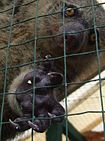](/wiki/File:Ailurops_ursinus_Naemundung_5_North_Sulawesi_cropped.JPG)
[](/wiki/File:Oppossumthumb.jpg)
Left: Opposable toes of the [Sulawesi bear
cuscus](/wiki/Sulawesi_bear_cuscus "Sulawesi bear cuscus") forelimb
Right: Opposable thumb on rear foot of an opossum
- In most [phalangerid](/wiki/Phalangerid "Phalangerid")
[marsupials](/wiki/Marsupial "Marsupial") (a family of
[possums](/wiki/Phalangeriformes "Phalangeriformes")) except species
*[Trichosurus](/wiki/Trichosurus "Trichosurus")* and
*[Wyulda](/wiki/Wyulda "Wyulda")*, the first and second toes of the
forefoot are opposable to the other three. In the hind foot, the
first toe is clawless but opposable and provides firm grip on
branches. The second and third toes are partly
[syndactylous](/wiki/Dactyly "Dactyly"), united by skin at the top
joint while the two separate nails serve as hair combs. The fourth
and fifth toes are the largest of the hind
foot.^([\[15\]](#cite_note-Nowak-1999-16))
- [Koalas](/wiki/Koala "Koala") have five toes on their fore and hind
feet with sharp curved claws except for the first toe of the hind
foot. The first and second toes of the forefeet are opposable to the
other three, which enables the koala to grip smaller branches and
search for fresh leaves in the outer canopy. Similar to the
phalangerids, the second and third toes of the hind foot are fused
but have separate claws.^([\[16\]](#cite_note-McDade-2003-koala-17))
- [Opossums](/wiki/Opossum "Opossum") are New World marsupials with
opposable thumbs in the hind feet giving these animals their
characteristic grasping capability (with the exception of the [water
opossum](/wiki/Water_opossum "Water opossum"), the webbed feet of
which restrict
opposability).^([\[17\]](#cite_note-McDade-2003-opossum-18))
- The mouse-like
[microbiotheres](/wiki/Microbiotheria "Microbiotheria") were a group
of South American marsupials most closely related to Australian
marsupials. The only extant member, *[Dromiciops
gliroides](/wiki/Monito_del_Monte "Monito del Monte")*, is not
closely related to opossums but has paws similar to these animals,
each having opposable toes adapted for
gripping.^([\[18\]](#cite_note-McDade-2003-microbiotheres-19))
### Reptiles
\[[edit](/w/index.php?title=Thumb&action=edit§ion=8 "Edit section: Reptiles")\]
- The front feet of [chameleons](/wiki/Chameleons "Chameleons") are
organized into a medial bundle of toes 1, 2 and 3, and a lateral
bundle of toes 4 and 5, and the hind feet are organized into a
medial bundle of toes 1 and 2, and a lateral bundle of toes 3, 4 and
5.^([\[19\]](#cite_note-20))
### Dinosaurs
\[[edit](/w/index.php?title=Thumb&action=edit§ion=9 "Edit section: Dinosaurs")\]
- Dinosaurs belonging to the family of bird-like dinosaur
[Troodontidae](/wiki/Troodontidae "Troodontidae") had a partially
opposable finger. It is possible that this adaptation was used to
better manipulate ground objects or moving undergrowth branches when
searching for prey.^([\[20\]](#cite_note-russell1982-21))
- The small predatory dinosaur
*[Bambiraptor](/wiki/Bambiraptor "Bambiraptor")* may have had
mutually opposable first and third fingers and a forelimb
manoeuvrability that would allow the hand to reach its mouth. Its
forelimb morphology and range of motion enabled two-handed
prehension, one-handed clutching of objects to the chest, and use of
the hand as a hook.^([\[21\]](#cite_note-22))
- *[Nqwebasaurus](/wiki/Nqwebasaurus "Nqwebasaurus")* — a
[coelurosaur](/wiki/Coelurosaur "Coelurosaur") with a long,
three-fingered hand which included a partially opposable thumb (a
"killer claw").^([\[22\]](#cite_note-23))
In addition to these, some other dinosaurs may have had partially or
completely opposed toes in order to manipulate food and/or grasp prey.
#### Birds
\[[edit](/w/index.php?title=Thumb&action=edit§ion=10 "Edit section: Birds")\]
[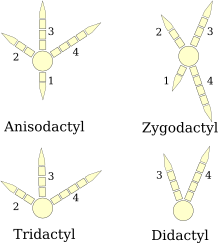](/wiki/File:Bird-feets-en.svg)
Four types of bird feet
(right foot diagrams)
See also: [Dactyly § Anisodactyly](/wiki/Dactyly#Anisodactyly "Dactyly")
- Most [birds](/wiki/Bird "Bird") have at least one opposable toe on
the foot, in [various
configurations](/wiki/Dactyly#In_birds "Dactyly"), though these are
seldom called "thumbs". They are more often known simply as
[halluxes](/wiki/Toe#Hallux "Toe").
#### Pterosaurs
\[[edit](/w/index.php?title=Thumb&action=edit§ion=11 "Edit section: Pterosaurs")\]
- The [wukongopterid](/wiki/Wukongopteridae "Wukongopteridae")
pterosaur *[Kunpengopterus](/wiki/Kunpengopterus "Kunpengopterus")*
bore an opposable first toe on each wing. The presence of opposable
thumbs in this taxon is thought to be an arboreal
adaptation.^([\[23\]](#cite_note-Zhouetal2021-24))
### Amphibians
\[[edit](/w/index.php?title=Thumb&action=edit§ion=12 "Edit section: Amphibians")\]
- *[Phyllomedusa](/wiki/Phyllomedusa "Phyllomedusa")*, a genus of
frogs native to South
America.^([\[24\]](#cite_note-Phyllomedusa-25))
## Human anatomy
\[[edit](/w/index.php?title=Thumb&action=edit§ion=13 "Edit section: Human anatomy")\]
### Skeleton
\[[edit](/w/index.php?title=Thumb&action=edit§ion=14 "Edit section: Skeleton")\]
The skeleton of the thumb consists of the [first metacarpal
bone](/wiki/First_metacarpal_bone "First metacarpal bone") which
articulates [proximally](/wiki/Proximal "Proximal") with the
[carpus](/wiki/Carpal_bones "Carpal bones") at the [carpometacarpal
joint](/wiki/Articulatio_carpometacarpea_pollicis "Articulatio carpometacarpea pollicis")
and [distally](/wiki/Distal "Distal") with the [proximal
phalanx](/wiki/Proximal_phalanges "Proximal phalanges") at the
[metacarpophalangeal
joint](/wiki/Metacarpophalangeal_joint "Metacarpophalangeal joint").
This latter bone articulates with the [distal
phalanx](/wiki/Distal_phalanges "Distal phalanges") at the
[interphalangeal
joint](/wiki/Interphalangeal_articulations_of_hand "Interphalangeal articulations of hand").
Additionally, there are two [sesamoid
bones](/wiki/Sesamoid_bone "Sesamoid bone") at the metacarpophalangeal
joint.
### Muscles
\[[edit](/w/index.php?title=Thumb&action=edit§ion=15 "Edit section: Muscles")\]
Main article: [Muscles of the
thumb](/wiki/Muscles_of_the_thumb "Muscles of the thumb")
The muscles of the thumb can be compared to
[guy-wires](/wiki/Guy-wire "Guy-wire") supporting a flagpole; tension
from these muscular guy-wires must be provided in all directions to
maintain stability in the articulated column formed by the bones of the
thumb. Because this stability is actively maintained by muscles rather
than by articular constraints, most muscles attached to the thumb tend
to be active during most thumb motions.^([\[25\]](#cite_note-26))
The muscles acting on the thumb can be divided into two groups: The
extrinsic hand muscles, with their muscle bellies located in the
forearm, and the intrinsic hand muscles, with their muscle bellies
located in the hand proper.^([\[26\]](#cite_note-27))
#### Extrinsic
\[[edit](/w/index.php?title=Thumb&action=edit§ion=16 "Edit section: Extrinsic")\]
[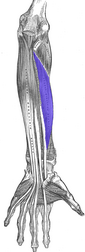](/wiki/File:Musculus_flexor_pollicis_longus.png)
[](/wiki/File:Gray419.png)
Flexor pollicis longus (left) and deep muscles of dorsal forearm (right)
A [ventral](/wiki/Ventral "Ventral") forearm muscle, the [flexor
pollicis
longus](/wiki/Flexor_pollicis_longus_muscle "Flexor pollicis longus muscle")
(FPL) originates on the anterior side of the
[radius](/wiki/Radius_(bone) "Radius (bone)") distal to the [radial
tuberosity](/wiki/Radial_tuberosity "Radial tuberosity") and from the
[interosseous
membrane](/wiki/Interosseous_membrane_of_forearm "Interosseous membrane of forearm").
It passes through the [carpal
tunnel](/wiki/Carpal_tunnel "Carpal tunnel") in a separate [tendon
sheath](/wiki/Tendon_sheath "Tendon sheath"), after which it lies
between the heads of the flexor pollicis brevis. It finally attaches
onto the base of the distal phalanx of the thumb. It is innervated by
the [anterior interosseus
branch](/wiki/Anterior_interosseous_nerve "Anterior interosseous nerve")
of the [median nerve](/wiki/Median_nerve "Median nerve")
(C7-C8)^([\[27\]](#cite_note-Platzer-162-28)) It is a persistence of one
of the former [contrahentes](/wiki/Contrahentes "Contrahentes") muscles
that pulled the fingers or toes together.
Three dorsal forearm muscles act on the thumb:
The [abductor pollicis
longus](/wiki/Abductor_pollicis_longus_muscle "Abductor pollicis longus muscle")
(APL) originates on the dorsal sides of both the
[ulna](/wiki/Ulna "Ulna") and the radius, and from the interosseous
membrane. Passing through the first tendon compartment, it inserts to
the base of the first [metacarpal bone](/wiki/Metacarpus "Metacarpus").
A part of the tendon reaches the trapezium, while another fuses with the
tendons of the extensor pollicis brevis and the abductor pollicis
brevis. Except for abducting the hand, it flexes the hand towards the
palm and abducts it radially. It is innervated by the [deep branch of
the radial
nerve](/wiki/Deep_branch_of_the_radial_nerve "Deep branch of the radial nerve")
(C7-C8).^([\[28\]](#cite_note-Platzer-168-29))
The [extensor pollicis
longus](/wiki/Extensor_pollicis_longus_muscle "Extensor pollicis longus muscle")
(EPL) originates on the dorsal side of the ulna and the interosseous
membrane. Passing through the third tendon compartment, it is inserted
onto the base of the distal phalanx of the thumb. It uses the dorsal
tubercle on the lower extremity of the radius as a
[fulcrum](/wiki/Lever "Lever") to extend the thumb and also dorsiflexes
and abducts the hand at the wrist. It is innervated by the [deep branch
of the radial
nerve](/wiki/Deep_branch_of_the_radial_nerve "Deep branch of the radial nerve")
(C7-C8).^([\[28\]](#cite_note-Platzer-168-29))
The [extensor pollicis
brevis](/wiki/Extensor_pollicis_brevis_muscle "Extensor pollicis brevis muscle")
(EPB) originates on the ulna distal to the abductor pollicis longus,
from the interosseus membrane, and from the dorsal side of the radius.
Passing through the first tendon compartment together with the abductor
pollicis longus, it is attached to the base of the proximal phalanx of
the thumb. It extends the thumb and, because of its close relationship
to the long abductor, also abducts the thumb. It is innervated by the
[deep branch of the radial
nerve](/wiki/Deep_branch_of_the_radial_nerve "Deep branch of the radial nerve")
(C7-T1).^([\[28\]](#cite_note-Platzer-168-29))
The tendons of the extensor pollicis longus and extensor pollicis brevis
form what is known as the [anatomical snuff
box](/wiki/Anatomical_snuff_box "Anatomical snuff box") (an indentation
on the lateral aspect of the thumb at its base) The radial artery can be
palpated anteriorly at the wrist (not in the snuffbox).
#### Intrinsic
\[[edit](/w/index.php?title=Thumb&action=edit§ion=17 "Edit section: Intrinsic")\]
[](/wiki/File:Gray426.png)
[](/wiki/File:Gray428.png)
Thenar (left) and dorsal interossei (right) muscles
There are three [thenar
muscles](/wiki/Thenar_eminence "Thenar eminence"):
The [abductor pollicis
brevis](/wiki/Abductor_pollicis_brevis_muscle "Abductor pollicis brevis muscle")
(APB) originates on the [scaphoid
tubercle](/wiki/Scaphoid_bone "Scaphoid bone") and the [flexor
retinaculum](/wiki/Flexor_retinaculum_of_the_hand "Flexor retinaculum of the hand").
It inserts to the radial sesamoid bone and the proximal phalanx of the
thumb. It is innervated by the [median
nerve](/wiki/Median_nerve "Median nerve")
(C8-T1).^([\[29\]](#cite_note-Platzer-176-30))
The [flexor pollicis
brevis](/wiki/Flexor_pollicis_brevis_muscle "Flexor pollicis brevis muscle")
(FPB) has two heads. The superficial head arises on the flexor
retinaculum, while the deep head originates on three carpal bones: the
[trapezium](/wiki/Trapezium_(bone) "Trapezium (bone)"),
[trapezoid](/wiki/Trapezoid_bone "Trapezoid bone"), and
[capitate](/wiki/Capitate_bone "Capitate bone"). The muscle is inserted
onto the radial sesamoid bone of the metacarpophalangeal joint. It acts
to flex, adduct, and abduct the thumb, and is therefore also able to
oppose the thumb. The superficial head is innervated by the [median
nerve](/wiki/Median_nerve "Median nerve"), while the deep head is
innervated by the [ulnar nerve](/wiki/Ulnar_nerve "Ulnar nerve")
(C8-T1).^([\[29\]](#cite_note-Platzer-176-30))
The [opponens
pollicis](/wiki/Opponens_pollicis_muscle "Opponens pollicis muscle")
originates on the tubercle of the trapezium and the flexor retinaculum.
It is inserted onto the radial side of the first metacarpal. It opposes
the thumb and assists in adduction. It is innervated by the [median
nerve](/wiki/Median_nerve "Median nerve").^([\[29\]](#cite_note-Platzer-176-30))
Other muscles involved are:
The [adductor
pollicis](/wiki/Adductor_pollicis_muscle "Adductor pollicis muscle")
also has two heads. The transversal head originates along the entire
third metacarpal bone, while the oblique head originates on the carpal
bones proximal to the third metacarpal. The muscle is inserted onto the
ulnar sesamoid bone of the metacarpophalangeal joint. It adducts the
thumb, and assists in opposition and flexion. It is innervated by the
deep branch of the [ulnar nerve](/wiki/Ulnar_nerve "Ulnar nerve")
(C8-T1).^([\[29\]](#cite_note-Platzer-176-30))
The first [dorsal
interosseous](/wiki/Dorsal_interossei_of_the_hand "Dorsal interossei of the hand"),
one of the central muscles of the hand, extends from the base of the
thumb metacarpal to the radial side of the proximal phalanx of the index
finger.^([\[30\]](#cite_note-Platzer-174-31))
### Variations
\[[edit](/w/index.php?title=Thumb&action=edit§ion=18 "Edit section: Variations")\]
Further information: [Hitchhiker's
thumb](/wiki/Hitchhiker%27s_thumb "Hitchhiker's thumb"), [brachydactyly
type D](/wiki/Brachydactyly_type_D "Brachydactyly type D"),
[triphalangeal thumb](/wiki/Triphalangeal_thumb "Triphalangeal thumb"),
and [polydactyly](/wiki/Polydactyly "Polydactyly")
[](/wiki/File:Hitchhikers_thumb.jpg)
[Hitchhiker's thumb](/wiki/Hitchhiker%27s_thumb "Hitchhiker's thumb")
There is a variation of the human thumb where the angle between the
first and second (proximal and distal)
[phalanges](/wiki/Distal_phalanges "Distal phalanges") varies between 0°
and almost 90° when the thumb is in a
[thumbs-up](/wiki/Thumbs_Up "Thumbs Up")
gesture.^([\[31\]](#cite_note-hitchthumbmyth-32))
It has been suggested that the variation is an autosomal [recessive
trait](/wiki/Recessive_trait "Recessive trait"), called a [hitchhiker's
thumb](/wiki/Hitchhiker%27s_thumb "Hitchhiker's thumb"), with
[homozygous](/wiki/Homozygous "Homozygous") carriers having an angle
close to 90°.^([\[32\]](#cite_note-33)) However this theory has been
disputed, since the variation in thumb angle is known to fall on a
continuum and shows little evidence of the
[bi-modality](/wiki/Bimodal_distribution "Bimodal distribution") seen in
other recessive genetic traits.^([\[31\]](#cite_note-hitchthumbmyth-32))
Other variations of the thumb include [brachydactyly type
D](/wiki/Brachydactyly_type_D "Brachydactyly type D") (which is a thumb
with a congenitally short distal phalanx), a [triphalangeal
thumb](/wiki/Triphalangeal_thumb "Triphalangeal thumb") (which is a
thumb which has 3 phalanges instead of the usual two), and
[polysyndactyly](/wiki/Polysyndactyly "Polysyndactyly") (which is a
combination of radial polydactyly and syndactyly).
### Grips
\[[edit](/w/index.php?title=Thumb&action=edit§ion=19 "Edit section: Grips")\]
[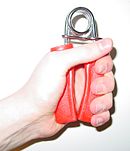](/wiki/File:Gripclosed.jpg)
[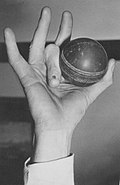](/wiki/File:Iverson_grip_1950.jpg)
Left: In a power grip the object is in contact with the palm.
Right: Cricketer [Jack Iverson's](/wiki/Jack_Iverson "Jack Iverson")
"bent finger grip", an unusual pad-to-side precision grip designed to
confuse batsmen.
One of the earlier significant contributors to the study of hand grips
was orthopedic primatologist and paleoanthropologist [John
Napier](/wiki/John_Napier_(primatologist) "John Napier (primatologist)"),
who proposed organizing the movements of the hand by their anatomical
basis as opposed to work done earlier that had only used arbitrary
classification.^([\[33\]](#cite_note-34)) Most of this early work on
hand grips had a pragmatic basis as it was intended to narrowly define
compensable injuries to the hand, which required an understanding of the
anatomical basis of hand movement. Napier proposed two primary
[prehensile](/wiki/Prehensile "Prehensile") grips: the *precision grip*
and the *power grip*.^([\[34\]](#cite_note-35)) The precision and power
grip are defined by the position of the thumb and fingers where:
- The **power grip** is when the fingers (and sometimes palm) clamp
down on an object with the thumb making counter pressure. Examples
of the power grip are gripping a hammer, opening a jar using *both
your palm and fingers*, and during pullups.
- The **precision grip** is when the intermediate and distal phalanges
("fingertips") and the thumb press against each other. Examples of a
precision grip are writing with a pencil, opening a jar *with the
fingertips alone*, and gripping a ball (only if the ball is not
tight against the palm).
[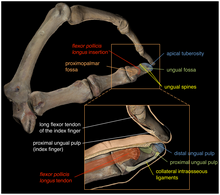](/wiki/File:Distal-phalanges-thumb-index_Journal.pone.0011727.g001.png)
Thumb and index finger during pad-to-pad precision
grasping^([\[35\]](#cite_note-PLOS-2010-36))
Opposability of the thumb should not be confused with a precision grip
as some animals possess semi-opposable thumbs yet are known to have
extensive precision grips ([Tufted
Capuchins](/wiki/Cebus_apella "Cebus apella") for
example).^([\[36\]](#cite_note-37)) Nevertheless, precision grips are
usually only found in higher apes, and only in degrees significantly
more restricted than in humans.^([\[37\]](#cite_note-38))
The pad-to-pad pinch between the thumb and index finger is made possible
because of the human ability to passively hyperextend the [distal
phalanx](/wiki/Distal_phalanges "Distal phalanges") of the index finger.
Most non-human primates have to flex their long fingers in order for the
small thumb to reach
them.^([\[9\]](#cite_note-Jones-Lederman-2006-p12-10))
In humans, the distal pads are wider than in other primates because the
soft tissues of the finger tip are attached to a horseshoe-shaped edge
on the underlying bone, and, in the grasping hand, the distal pads can
therefore conform to uneven surfaces while pressure is distributed more
evenly in the finger tips. The distal pad of the human thumb is divided
into a proximal and a distal compartment, the former more deformable
than the latter, which allows the thumb pad to mold around an
object.^([\[9\]](#cite_note-Jones-Lederman-2006-p12-10))
In robotics, almost all [robotic
hands](/wiki/Robotic_hand "Robotic hand") have a long and strong
opposable thumb. Like human hands, the thumb of a robotic hand also
plays a key role in gripping an object. One inspiring approach of
robotic grip planning is to mimic human thumb placement.
^([\[38\]](#cite_note-39)) In a sense, human thumb placement indicates
which surface or part of the object is good for grip. Then the robot
places its thumb to the same location and plans the other fingers based
on the thumb placement.
The function of the thumb declines physiologically with aging. This can
be demonstrated by assessing the motor sequencing of the
thumb.^([\[39\]](#cite_note-40))
## Human evolution
\[[edit](/w/index.php?title=Thumb&action=edit§ion=20 "Edit section: Human evolution")\]
A primitive autonomization of the first [carpometacarpal
joint](/wiki/Carpometacarpal_joint "Carpometacarpal joint") (CMC) may
have occurred in dinosaurs. A real differentiation appeared an estimated
70 mya in early primates, while the shape of the human thumb CMC finally
appears about 5 mya. The result of this evolutionary process is a human
CMC joint positioned at 80° of pronation, 40 of abduction, and 50° of
flexion in relation to an axis passing through the second and third CMC
joints.^([\[40\]](#cite_note-Brüser-167-41))
Opposable thumbs are shared by some [primates](/wiki/Primate "Primate"),
including most
[catarrhines](/wiki/Catarrhini "Catarrhini").^(\[*[citation\ needed](/wiki/Wikipedia:Citation_needed "Wikipedia:Citation needed")*\])
The climbing and suspensory behaviour in
[orthograde](/wiki/Orthograde_posture "Orthograde posture") apes, such
as [chimpanzees](/wiki/Common_chimpanzee "Common chimpanzee"), has
resulted in elongated hands while the thumb has remained short. As a
result, these primates are unable to perform the pad-to-pad grip
associated with opposability. However, in
[pronograde](/wiki/Pronograde "Pronograde") monkeys such as
[baboons](/wiki/Baboon "Baboon"), an adaptation to a terrestrial
lifestyle has led to reduced finger length and thus hand proportions
similar to those of humans. Consequently, these primates have dexterous
hands and are able to grasp objects using a pad-to-pad grip. It can thus
be difficult to identify hand adaptations to manipulation-related tasks
based solely on thumb
proportions.^([\[41\]](#cite_note-Moyà-Solà-1999-42))
The evolution of the fully opposable thumb is usually associated with
*[Homo habilis](/wiki/Homo_habilis "Homo habilis")*, a forerunner of
*[Homo
sapiens](/wiki/Homo_sapiens "Homo sapiens")*.^([\[42\]](#cite_note-43))
This, however, is the suggested result of evolution from *[Homo
erectus](/wiki/Homo_erectus "Homo erectus")* (around 1
[mya](/wiki/Mya_(unit) "Mya (unit)")) via a series of intermediate
[anthropoid](/wiki/Simian "Simian") stages, and is therefore a much more
complicated link.
Modern humans are unique in the musculature of their forearm and hand.
Yet, they remain autapomorphic, meaning each muscle is found in one or
more non-human primates. The extensor pollicis brevis and flexor
pollicis longus allow modern humans to have great manipulative skills
and strong flexion in the thumb.^([\[43\]](#cite_note-44))
However, a more likely scenario may be that the specialized precision
gripping hand (equipped with opposable thumb) of *[Homo
habilis](/wiki/Homo_habilis "Homo habilis")* preceded walking, with the
specialized adaptation of the spine, pelvis, and lower extremities
preceding a more advanced hand. And, it is logical that a conservative,
highly functional adaptation be followed by a series of more complex
ones that complement it. With *[Homo
habilis](/wiki/Homo_habilis "Homo habilis")*, an advanced
grasping-capable hand was accompanied by facultative
[bipedalism](/wiki/Bipedalism "Bipedalism"), possibly implying, assuming
a co-opted evolutionary relationship exists, that the latter resulted
from the former as obligate bipedalism was yet to
follow.^([\[44\]](#cite_note-45)) Walking may have been a by-product of
busy hands and not vice versa.
[HACNS1](/wiki/HACNS1 "HACNS1") (also known as [Human Accelerated
Region](/wiki/Human_accelerated_regions "Human accelerated regions") 2)
is a [gene enhancer](/wiki/Enhancer_(genetics) "Enhancer (genetics)")
"that may have contributed to the evolution of the uniquely opposable
human thumb, and possibly also modifications in the
[ankle](/wiki/Ankle "Ankle") or [foot](/wiki/Foot "Foot") that allow
humans to [walk](/wiki/Walk "Walk") on two legs". Evidence to date shows
that of the 110,000 gene enhancer sequences identified in the human
[genome](/wiki/Genome "Genome"), HACNS1 has undergone the most change
during the [human evolution](/wiki/Human_evolution "Human evolution")
since the [chimpanzee–human last common
ancestor](/wiki/Chimpanzee%E2%80%93human_last_common_ancestor "Chimpanzee–human last common ancestor").^([\[45\]](#cite_note-46))
## See also
\[[edit](/w/index.php?title=Thumb&action=edit§ion=21 "Edit section: See also")\]
- [Pollicization](/wiki/Pollicization "Pollicization")
- [Prehensility](/wiki/Prehensility "Prehensility")
- [Thumb signal](/wiki/Thumb_signal "Thumb signal")
- [Thumb twiddling](/wiki/Thumb_twiddling "Thumb twiddling")
- [Thumb war](/wiki/Thumb_war "Thumb war")
## Notes
\[[edit](/w/index.php?title=Thumb&action=edit§ion=22 "Edit section: Notes")\]
1. **[^](#cite_ref-1)**
[clinicalconsiderations](http://www.wesnorman.com/clinicalconsiderations.htm)
at The Anatomy Lesson by Wesley Norman (Georgetown University)
2. **[^](#cite_ref-3)**
["Definition of
FINGER"](https://www.merriam-webster.com/dictionary/finger).
*www.merriam-webster.com*. 2024-09-26. Retrieved 2024-09-30.
3. **[^](#cite_ref-4)** Haeri, Seyed Mohammad Jafar, et al. "Human
thumb consists of three phalanges and lacks metacarpal? A
morphometric study on the long bones of the hand." Surgical and
Radiologic Anatomy 44.8 (2022):
1101-1109.[https://doi.org/10.1007/s00276-022-02986-9](https://doi.org/10.1007/s00276-022-02986-9)
4. ^ [^(***a***)](#cite_ref-vanNierop-2008_5-0)
[^(***b***)](#cite_ref-vanNierop-2008_5-1) [van Nierop et al.
2008](#CITEREFvan_Nieropvan_der_HelmOverbeekeDjajadiningrat2008),
p. 34
5. **[^](#cite_ref-Brownetal-2004_6-0)** [Brown et al.
2004](#CITEREFBrownFreemanCuccurulloFreeman2004)
6. **[^](#cite_ref-Primates-FAQ_7-0)** ["Primates FAQ: Do any primates
have opposable thumbs?"](https://www.primates.com/faq/). Wisconsin
Regional Primate Research Center. Retrieved 20 November 2010.
7. **[^](#cite_ref-8)** ["The Thumb is the
Hero"](https://query.nytimes.com/gst/fullpage.html?res=9F04E3D8173BF932A25752C0A967948260).
*The New York Times*. January 11, 1981. Retrieved 20 November 2010.
“The "fishing rod" a chimp strips of leaves and pokes into a termite
nest to bring up a snack is as far as he'll ever get toward orbiting
the planets.”
8. **[^](#cite_ref-PrimateAnatomy8_9-0)** [Ankel-Simons
2007](#CITEREFAnkel-Simons2007), p. 345
9. ^ [^(***a***)](#cite_ref-Jones-Lederman-2006-p12_10-0)
[^(***b***)](#cite_ref-Jones-Lederman-2006-p12_10-1)
[^(***c***)](#cite_ref-Jones-Lederman-2006-p12_10-2) [Jones &
Lederman 2006](#CITEREFJonesLederman2006), Evolutionary Development
and Anatomy of the Hand, p. 12
10. **[^](#cite_ref-PloS-Darwinius-2009_11-0)** [Franzen et al.
2009](#CITEREFFranzenGingerichHabersetzerHurum2009), pp. 15–18
11. **[^](#cite_ref-12)** ["The Panda's
Thumb"](http://www.athro.com/evo/pthumb.html). Athro. 2000.
Retrieved 21 November 2010.
12. **[^](#cite_ref-order_13-0)** Stefoff, Rebecca (2008). [*The Rodent
Order*](https://books.google.com/books?id=7Gle7-L46TYC&pg=PA63).
Marshall Cavendish. pp. 62–63, 71–73.
[ISBN](/wiki/ISBN_(identifier) "ISBN (identifier)") [978-0-7614-3073-5](/wiki/Special:BookSources/978-0-7614-3073-5 "Special:BookSources/978-0-7614-3073-5").
13. **[^](#cite_ref-14)** [Ellerman 1941](#CITEREFEllerman1941), p. 2
14. **[^](#cite_ref-15)** Grzimek, Bernhard (2003). Hutchins, Michael;
Kleiman, Devra G.; Geist, Valerius; et al. (eds.). [*Grzimek's
Animal Life Encyclopedia, Vol 16, Mammals
V*](https://archive.org/details/grzimeksanimalli0002grzi_c1l6/page/293/mode/2up)
(2nd ed.). Farmington Hills, MI: Gale Group. p. 293.
[ISBN](/wiki/ISBN_(identifier) "ISBN (identifier)") [978-0-7876-7750-3](/wiki/Special:BookSources/978-0-7876-7750-3 "Special:BookSources/978-0-7876-7750-3").
15. **[^](#cite_ref-Nowak-1999_16-0)** [Nowak 1999](#CITEREFNowak1999),
p. 89
16. **[^](#cite_ref-McDade-2003-koala_17-0)** [McDade
2003](#CITEREFMcDade2003), vol 13, p. 44
17. **[^](#cite_ref-McDade-2003-opossum_18-0)** [McDade
2003](#CITEREFMcDade2003), vol 12, p. 250
18. **[^](#cite_ref-McDade-2003-microbiotheres_19-0)** [McDade
2003](#CITEREFMcDade2003), vol 12, p. 274
19. **[^](#cite_ref-20)** Anderson, Christopher V. & Higham, Timothy E.
(2014). "Chameleon anatomy". In Tolley, Krystal A. & Herrel, Anthony
(eds.). *The Biology of Chameleons*. Berkeley: University of
California Press. pp. 7–55.
[ISBN](/wiki/ISBN_(identifier) "ISBN (identifier)") [9780520276055](/wiki/Special:BookSources/9780520276055 "Special:BookSources/9780520276055").
20. **[^](#cite_ref-russell1982_21-0)** Russell, D. A.; Séguin, R.
(1982). ["Reconstruction of the small Cretaceous theropod
*Stenonychosaurus inequalis* and a hypothetical
dinosauroid"](https://archive.org/details/syllogeus37nati).
*Syllogeus*. **37**: 1–43.
21. **[^](#cite_ref-22)** [Senter 2006](#CITEREFSenter2006)
22. **[^](#cite_ref-23)** [de Klerk et al.
2000](#CITEREFde_KlerkForsterSampsonChinsamy2000), p. 327. *The left
manus shows that the flexed digit I had the potential to partially
oppose digits II and III.*
23. **[^](#cite_ref-Zhouetal2021_24-0)** Zhou, X.; Pêgas, R. V.; Ma, W.;
Han, G.; Jin, X.; Leal, M. E. C.; Bonde, N.; Kobayashi, Y.;
Lautenschlager, S.; Wei, X.; Shen, C.; Ji, S. (2021). ["A new
darwinopteran pterosaur reveals arborealism and an opposed
thumb"](https://doi.org/10.1016%2Fj.cub.2021.03.030). *[Current
Biology](/wiki/Current_Biology "Current Biology")*. **31** (11):
2429–2436.e7.
[Bibcode](/wiki/Bibcode_(identifier) "Bibcode (identifier)"):[2021CBio...31E2429Z](https://ui.adsabs.harvard.edu/abs/2021CBio...31E2429Z).
[doi](/wiki/Doi_(identifier) "Doi (identifier)"):[10.1016/j.cub.2021.03.030](https://doi.org/10.1016%2Fj.cub.2021.03.030).
[PMID](/wiki/PMID_(identifier) "PMID (identifier)") [33848460](https://pubmed.ncbi.nlm.nih.gov/33848460).
24. **[^](#cite_ref-Phyllomedusa_25-0)** Bertoluci, Jaime (18 December
2002). ["Pedal luring in the leaf-frog Phyllomedusa burmeisteri
(Anura, Hylidae,
Phyllomedusinae)"](https://doi.org/10.11606%2Fissn.2316-9079.v1i2p93-95).
*Phyllomedusa: Journal of Herpetology*. **1** (2): 93.
[doi](/wiki/Doi_(identifier) "Doi (identifier)"):[10.11606/issn.2316-9079.v1i2p93-95](https://doi.org/10.11606%2Fissn.2316-9079.v1i2p93-95).
25. **[^](#cite_ref-26)** [Austin 2005](#CITEREFAustin2005), p. 339
26. **[^](#cite_ref-27)** ["Muscles of the
thumb"](http://www.eatonhand.com/mus/mus131.htm). Eaton hand.
Retrieved 11 May 2010.
27. **[^](#cite_ref-Platzer-162_28-0)** [Platzer
2004](#CITEREFPlatzer2004), p. 162
28. ^ [^(***a***)](#cite_ref-Platzer-168_29-0)
[^(***b***)](#cite_ref-Platzer-168_29-1)
[^(***c***)](#cite_ref-Platzer-168_29-2) [Platzer
2004](#CITEREFPlatzer2004), p. 168
29. ^ [^(***a***)](#cite_ref-Platzer-176_30-0)
[^(***b***)](#cite_ref-Platzer-176_30-1)
[^(***c***)](#cite_ref-Platzer-176_30-2)
[^(***d***)](#cite_ref-Platzer-176_30-3) [Platzer
2004](#CITEREFPlatzer2004), p. 176
30. **[^](#cite_ref-Platzer-174_31-0)** [Platzer
2004](#CITEREFPlatzer2004), p. 174
31. ^ [^(***a***)](#cite_ref-hitchthumbmyth_32-0)
[^(***b***)](#cite_ref-hitchthumbmyth_32-1) ["Myth's of Human
Genetics: Hitchhiker's
Thumb"](http://udel.edu/~mcdonald/myththumb.html). Retrieved 7
November 2012.
32. **[^](#cite_ref-33)** ["Thumb, Distal Hyperextensibility
of"](https://www.ncbi.nlm.nih.gov/entrez/dispomim.cgi?id=274200).
*OMIM*. NCBI. Retrieved 5 February 2010.
33. **[^](#cite_ref-34)** [Slocum & Pratt
1946](#CITEREFSlocumPratt1946), [McBride 1942](#CITEREFMcBride1942),
p. 631
34. **[^](#cite_ref-35)** [Napier 1956](#CITEREFNapier1956), pp. 902–913
35. **[^](#cite_ref-PLOS-2010_36-0)** [Almécija, Moyà-Solà & Alba
2010](#CITEREFAlmécijaMoyà-SolàAlba2010)
36. **[^](#cite_ref-37)** [Costello & Fragaszy
1988](#CITEREFCostelloFragaszy1988), pp. 235–245
37. **[^](#cite_ref-38)** [Young 2003](#CITEREFYoung2003), pp. 165–174,
[Christel, Kitzel & Niemitz
2004](#CITEREFChristelKitzelNiemitz2004), pp. 165–194, [Byrne &
Byrne 1993](#CITEREFByrneByrne1993), p. 241
38. **[^](#cite_ref-39)** Lin, Yun; Sun, Yu (2015). "Robot grasp
planning based on demonstrated grasp strategies". *The International
Journal of Robotics Research*. **34**: 26–42.
[doi](/wiki/Doi_(identifier) "Doi (identifier)"):[10.1177/0278364914555544](https://doi.org/10.1177%2F0278364914555544).
[S2CID](/wiki/S2CID_(identifier) "S2CID (identifier)") [10178250](https://api.semanticscholar.org/CorpusID:10178250).
39. **[^](#cite_ref-40)** Bodranghien, Florian; Mahé, Helene; Baude,
Benjamin; Manto, Mario U.; Busegnies, Yves; Camut, Stéphane; Habas,
Christophe; Marien, Peter; de Marco, Giovanni (2017-05-10). ["The
Click Test: A Novel Tool to Quantify the Age-Related Decline of Fast
Motor Sequencing of the
Thumb"](https://hal.parisnanterre.fr//hal-02310540/file/Bodranghienetal.TheClickTestANovelTooltoQuantifytheAge-RelatedDeclineofFastMotorSequencingoftheThumbCurrentagingscience2017.pdf)
(PDF). *Current Aging Science*. **10** (4): 305–318.
[doi](/wiki/Doi_(identifier) "Doi (identifier)"):[10.2174/1874609810666170511100318](https://doi.org/10.2174%2F1874609810666170511100318).
[ISSN](/wiki/ISSN_(identifier) "ISSN (identifier)") [1874-6128](https://search.worldcat.org/issn/1874-6128).
[PMID](/wiki/PMID_(identifier) "PMID (identifier)") [28494715](https://pubmed.ncbi.nlm.nih.gov/28494715).
40. **[^](#cite_ref-Brüser-167_41-0)** [Brunelli
1999](#CITEREFBrunelli1999), p. 167
41. **[^](#cite_ref-Moyà-Solà-1999_42-0)** [Moyà-Solà, Köhler & Rook
1999](#CITEREFMoyà-SolàKöhlerRook1999), pp. 315–6
42. **[^](#cite_ref-43)** [Leakey, Tobias & Napier
1964](#CITEREFLeakeyTobiasNapier1964): "\[In Homo habilis\] the
pollex is well developed and fully opposable and the hand is capable
not only of a power grip but of, at least, a simple and usually well
developed precision grip."
43. **[^](#cite_ref-44)** Diogo, R.; Richmond, B. G.; Wood, B. (2012).
"Evolution and homologies of primate and modern human hand and
forearm muscles, with notes on thumb movements and tool use".
*Journal of Human Evolution*. **63** (1): 64–78.
[Bibcode](/wiki/Bibcode_(identifier) "Bibcode (identifier)"):[2012JHumE..63...64D](https://ui.adsabs.harvard.edu/abs/2012JHumE..63...64D).
[doi](/wiki/Doi_(identifier) "Doi (identifier)"):[10.1016/j.jhevol.2012.04.001](https://doi.org/10.1016%2Fj.jhevol.2012.04.001).
[PMID](/wiki/PMID_(identifier) "PMID (identifier)") [22640954](https://pubmed.ncbi.nlm.nih.gov/22640954).
44. **[^](#cite_ref-45)** [Harcourt-Smith & Aiello
2004](#CITEREFHarcourt-SmithAiello2004)
45. **[^](#cite_ref-46)** ["HACNS1: Gene enhancer in evolution of human
opposable
thumb"](http://www.sciencecodex.com/gene_enhancer_in_evolution_of_human_opposable_thumb).
Science Codex. September 4, 2008. Retrieved December 16, 2009.
1. **[^](#cite_ref-2)** In some countries and cultures, the thumb is
considered a finger. Elsewhere, it is considered a 'digit' due to
the few features it has in difference with the other four digits,
such as the larger gap, missing phalanx and horizontal curling
movement.
## References
\[[edit](/w/index.php?title=Thumb&action=edit§ion=23 "Edit section: References")\]
- Almécija, S.; Moyà-Solà, S.; Alba, D. M. (2010). ["Early Origin for
Human-Like Precision Grasping: A Comparative Study of Pollical
Distal Phalanges in Fossil
Hominins"](https://www.ncbi.nlm.nih.gov/pmc/articles/PMC2908684).
*PLOS ONE*. **5** (7): e11727.
[Bibcode](/wiki/Bibcode_(identifier) "Bibcode (identifier)"):[2010PLoSO...511727A](https://ui.adsabs.harvard.edu/abs/2010PLoSO...511727A).
[doi](/wiki/Doi_(identifier) "Doi (identifier)"):[10.1371/journal.pone.0011727](https://doi.org/10.1371%2Fjournal.pone.0011727).
[PMC](/wiki/PMC_(identifier) "PMC (identifier)") [2908684](https://www.ncbi.nlm.nih.gov/pmc/articles/PMC2908684).
[PMID](/wiki/PMID_(identifier) "PMID (identifier)") [20661444](https://pubmed.ncbi.nlm.nih.gov/20661444).
- Ankel-Simons, Friderun (2007). "Chapter 8: Postcranial Skeleton".
*Primate Anatomy* (3rd ed.). Academic Press. p. 345.
[ISBN](/wiki/ISBN_(identifier) "ISBN (identifier)") [978-0-12-372576-9](/wiki/Special:BookSources/978-0-12-372576-9 "Special:BookSources/978-0-12-372576-9").
- Austin, Noelle M. (2005). "Chapter 9: The Wrist and Hand Complex".
In Levangie, Pamela K.; Norkin, Cynthia C. (eds.). *Joint Structure
and Function: A Comprehensive Analysis* (4th ed.).
Philadelphia: F. A. Davis Company.
[ISBN](/wiki/ISBN_(identifier) "ISBN (identifier)") [978-0-8036-1191-7](/wiki/Special:BookSources/978-0-8036-1191-7 "Special:BookSources/978-0-8036-1191-7").
- Brown, David P.; Freeman, Eric D.; Cuccurullo, Sara; Freeman, Ted L.
(2004). ["Upper Extremities—Hand Region: Range of Motion of the
Digits"](https://www.ncbi.nlm.nih.gov/bookshelf/br.fcgi?book=physmedrehab&part=A4492#A4530).
In Cuccurullo, Sara (ed.). *Physical Medicine and Rehabilitation
Board Review*. Demos Medical Publishing.
[ISBN](/wiki/ISBN_(identifier) "ISBN (identifier)") [978-1-888799-45-3](/wiki/Special:BookSources/978-1-888799-45-3 "Special:BookSources/978-1-888799-45-3").
([NCBI](/wiki/National_Center_for_Biotechnology_Information "National Center for Biotechnology Information"))
- Brunelli, Giovanni R. (1999). ["Stability in the first
carpometacarpal
joint"](https://books.google.com/books?id=-pzGRMvXFzAC&pg=PA167). In
Brüser, Peter; Gilbert, Alain (eds.). *Finger bone and joint
injuries*. Taylor & Francis.
[ISBN](/wiki/ISBN_(identifier) "ISBN (identifier)") [978-1-85317-690-6](/wiki/Special:BookSources/978-1-85317-690-6 "Special:BookSources/978-1-85317-690-6").
- Byrne, R.W.; Byrne, J.M.E. (1993). ["Complex Leaf-Gathering Skills
of Mountain Gorillas (Gorilla g. beringei): Variability and
Standardization"](https://web.archive.org/web/20090920100630/http://www.st-andrews.ac.uk/~www_sp/people/personal/rwb/publications/1993%20Byrne_Byrne_AJP.pdf)
(PDF). *American Journal of Primatology*. **31** (4): 241–261.
[doi](/wiki/Doi_(identifier) "Doi (identifier)"):[10.1002/ajp.1350310402](https://doi.org/10.1002%2Fajp.1350310402).
[ISSN](/wiki/ISSN_(identifier) "ISSN (identifier)") [0275-2565](https://search.worldcat.org/issn/0275-2565).
[PMID](/wiki/PMID_(identifier) "PMID (identifier)") [31936992](https://pubmed.ncbi.nlm.nih.gov/31936992).
[S2CID](/wiki/S2CID_(identifier) "S2CID (identifier)") [84429453](https://api.semanticscholar.org/CorpusID:84429453).
Archived from [the
original](http://www.st-andrews.ac.uk/~www_sp/people/personal/rwb/publications/1993%20Byrne_Byrne_AJP.pdf)
(PDF) on September 20, 2009.
- Christel, Marianne I.; Kitzel, Stefanie; [Niemitz,
Carsten](/wiki/Carsten_Niemitz "Carsten Niemitz") (30 November
2004). "How Precisely do Bonobos (Pan paniscus) Grasp Small
Objects?". *International Journal of Primatology*. **19** (1):
165–194.
[doi](/wiki/Doi_(identifier) "Doi (identifier)"):[10.1023/A:1020319313219](https://doi.org/10.1023%2FA%3A1020319313219).
[S2CID](/wiki/S2CID_(identifier) "S2CID (identifier)") [23567551](https://api.semanticscholar.org/CorpusID:23567551).
- Costello, Michael B.; Fragaszy, Dorothy M. (March 1988).
["Prehension in Cebus and Saimiri: I. Grip type and hand
preference"](http://www3.interscience.wiley.com/cgi-bin/fulltext/110487513/PDFSTART).
*American Journal of Primatology*. **15** (3): 235–245.
[doi](/wiki/Doi_(identifier) "Doi (identifier)"):[10.1002/ajp.1350150306](https://doi.org/10.1002%2Fajp.1350150306).
[PMID](/wiki/PMID_(identifier) "PMID (identifier)") [31968893](https://pubmed.ncbi.nlm.nih.gov/31968893).
[S2CID](/wiki/S2CID_(identifier) "S2CID (identifier)") [86556774](https://api.semanticscholar.org/CorpusID:86556774).^(\[*[dead\ link](/wiki/Wikipedia:Link_rot "Wikipedia:Link rot")*\])
- de Klerk, W.J.; Forster, C.A.; Sampson, S.D.; Chinsamy, A.; Ross,
C.F. (2000). ["A new coelurosaurian dinosaur from the Early
Cretaceous of South
Africa"](https://wayback.archive-it.org/all/20120130211657/http://rosslab.uchicago.edu/publications/De%20Klerk%20et%20al.%202000.pdf)
(PDF). *Journal of Vertebrate Paleontology*. **20** (2): 324–332.
[doi](/wiki/Doi_(identifier) "Doi (identifier)"):[10.1671/0272-4634(2000)020\[0324:ancdft\]2.0.co;2](https://doi.org/10.1671%2F0272-4634%282000%29020%5B0324%3Aancdft%5D2.0.co%3B2).
[S2CID](/wiki/S2CID_(identifier) "S2CID (identifier)") [128622530](https://api.semanticscholar.org/CorpusID:128622530).
Archived from [the
original](http://rosslab.uchicago.edu/publications/De%20Klerk%20et%20al.%202000.pdf)
(PDF) on 2012-01-30.
- Diogo, R; Richmond, BG; Wood, B (2012). "Evolution and homologies of
primate and modern human hand and forearm muscles, with notes on
thumb movements and tool use". *Journal of Human Evolution*. **63**
(1): 64–78.
[Bibcode](/wiki/Bibcode_(identifier) "Bibcode (identifier)"):[2012JHumE..63...64D](https://ui.adsabs.harvard.edu/abs/2012JHumE..63...64D).
[doi](/wiki/Doi_(identifier) "Doi (identifier)"):[10.1016/j.jhevol.2012.04.001](https://doi.org/10.1016%2Fj.jhevol.2012.04.001).
[PMID](/wiki/PMID_(identifier) "PMID (identifier)") [22640954](https://pubmed.ncbi.nlm.nih.gov/22640954).
- Ellerman, John Reeves (1941). [*The families and genera of living
rodents. Vol. II. Family
Muridae*](https://archive.org/stream/familiesgeneraof02elle#page/2/mode/2up/search/Lophiomyidae).
London: British Museum (Natural History).
- Franzen, JL; Gingerich, PD; Habersetzer, J; Hurum, JH; von
Koenigswald, W; et al. (2009). Hawks, John (ed.). ["Complete Primate
Skeleton from the Middle Eocene of Messel in Germany: Morphology and
Paleobiology"](https://www.ncbi.nlm.nih.gov/pmc/articles/PMC2683573).
*PLOS ONE*. **4** (5): e5723.
[Bibcode](/wiki/Bibcode_(identifier) "Bibcode (identifier)"):[2009PLoSO...4.5723F](https://ui.adsabs.harvard.edu/abs/2009PLoSO...4.5723F).
[doi](/wiki/Doi_(identifier) "Doi (identifier)"):[10.1371/journal.pone.0005723](https://doi.org/10.1371%2Fjournal.pone.0005723).
[PMC](/wiki/PMC_(identifier) "PMC (identifier)") [2683573](https://www.ncbi.nlm.nih.gov/pmc/articles/PMC2683573).
[PMID](/wiki/PMID_(identifier) "PMID (identifier)") [19492084](https://pubmed.ncbi.nlm.nih.gov/19492084).
- Harcourt-Smith, W E H; Aiello, L C (May 2004). ["Fossils, feet and
the evolution of human bipedal
locomotion"](https://www.ncbi.nlm.nih.gov/pmc/articles/PMC1571304).
*Journal of Anatomy*. **204** (5): 403–16.
[doi](/wiki/Doi_(identifier) "Doi (identifier)"):[10.1111/j.0021-8782.2004.00296.x](https://doi.org/10.1111%2Fj.0021-8782.2004.00296.x).
[PMC](/wiki/PMC_(identifier) "PMC (identifier)") [1571304](https://www.ncbi.nlm.nih.gov/pmc/articles/PMC1571304).
[PMID](/wiki/PMID_(identifier) "PMID (identifier)") [15198703](https://pubmed.ncbi.nlm.nih.gov/15198703).
- Hsu, Ar-Tyan; Meng-Tsu Hu; Fong Ching Su (July 2008). ["Effect of
Gender, Flexibility and Thumb Type on Thumb Tip
Generation"](http://www.jbiomech.com/article/S0021-9290%2808%2970148-9/abstract).
*Journal of Biomechanics*. **41** (Supplement 1): S148.
[doi](/wiki/Doi_(identifier) "Doi (identifier)"):[10.1016/S0021-9290(08)70148-9](https://doi.org/10.1016%2FS0021-9290%2808%2970148-9).
- [Jones, Lynette A.](/wiki/Lynette_Jones "Lynette Jones"); [Lederman,
Susan J.](/wiki/Susan_Lederman "Susan Lederman") (2006). [*Human
hand
function*](https://archive.org/details/humanhandfunctio0000jone).
Oxford University Press US.
[ISBN](/wiki/ISBN_(identifier) "ISBN (identifier)") [9780195173154](/wiki/Special:BookSources/9780195173154 "Special:BookSources/9780195173154").
- [Leakey, LSB](/wiki/Louis_Leakey "Louis Leakey"); [Tobias,
PV](/wiki/Phillip_V._Tobias "Phillip V. Tobias"); [Napier,
JR](/wiki/John_Napier_(primatologist) "John Napier (primatologist)")
(April 1964). ["A New Species of Genus Homo from Olduvai
Gorge"](http://purple.niagara.edu/wje/Bio121/Leaky%201964%20habilis.pdf)
(PDF). *Nature*. **202** (4927): 7–9.
[Bibcode](/wiki/Bibcode_(identifier) "Bibcode (identifier)"):[1964Natur.202....7L](https://ui.adsabs.harvard.edu/abs/1964Natur.202....7L).
[doi](/wiki/Doi_(identifier) "Doi (identifier)"):[10.1038/202007a0](https://doi.org/10.1038%2F202007a0).
[PMID](/wiki/PMID_(identifier) "PMID (identifier)") [14166722](https://pubmed.ncbi.nlm.nih.gov/14166722).
[S2CID](/wiki/S2CID_(identifier) "S2CID (identifier)") [12836722](https://api.semanticscholar.org/CorpusID:12836722).^(\[*[permanent\ dead\ link](/wiki/Wikipedia:Link_rot "Wikipedia:Link rot")*\])
- McBride, Earl Duwain (1942). [*Disability evaluation: principles of
treatment of compensable
injuries*](https://books.google.com/books?id=YIpgQgAACAAJ).
Lippincott. p. 631.
- McDade, Melissa C. (2003). "Koalas (*Phascolartidae*)". In Hutchins,
Michael; Kleiman, Devra G.; Geist, Valerius; et al. (eds.).
*Grzimek's animal life encyclopedia: Volumes 12–16, Mammals I–V*
(2nd ed.). Farmington Hills, MI: Gale Group.
- Moyà-Solà, Salvador; Köhler, Meike; Rook, Lorenzo (January 5, 1999).
["Evidence of hominid-like precision grip capability in the hand of
the Miocene ape
Oreopithecus"](http://www.pnas.org/content/96/1/313.full.pdf) (PDF).
*PNAS*. **96** (1): 313–317.
[Bibcode](/wiki/Bibcode_(identifier) "Bibcode (identifier)"):[1999PNAS...96..313M](https://ui.adsabs.harvard.edu/abs/1999PNAS...96..313M).
[doi](/wiki/Doi_(identifier) "Doi (identifier)"):[10.1073/pnas.96.1.313](https://doi.org/10.1073%2Fpnas.96.1.313).
[PMC](/wiki/PMC_(identifier) "PMC (identifier)") [15136](https://www.ncbi.nlm.nih.gov/pmc/articles/PMC15136).
[PMID](/wiki/PMID_(identifier) "PMID (identifier)") [9874815](https://pubmed.ncbi.nlm.nih.gov/9874815).
- Napier, John Russell (November 1956). ["The prehensile movements of
the human hand"](https://doi.org/10.1302%2F0301-620X.38B4.902). *J
Bone Joint Surg Br*. **38** (4): 902–913.
[doi](/wiki/Doi_(identifier) "Doi (identifier)"):[10.1302/0301-620X.38B4.902](https://doi.org/10.1302%2F0301-620X.38B4.902).
[PMID](/wiki/PMID_(identifier) "PMID (identifier)") [13376678](https://pubmed.ncbi.nlm.nih.gov/13376678).
- Nowak, Ronald M. (1999). [*Walker's mammals of the world, Volume
2*](https://books.google.com/books?id=T37sFCl43E8C&pg=PA89)
(6th ed.). JHU Press.
[ISBN](/wiki/ISBN_(identifier) "ISBN (identifier)") [978-0-8018-5789-8](/wiki/Special:BookSources/978-0-8018-5789-8 "Special:BookSources/978-0-8018-5789-8").
- Platzer, Werner (2004). *Color Atlas of Human Anatomy, Vol. 1:
Locomotor System* (5th ed.). Thieme.
[ISBN](/wiki/ISBN_(identifier) "ISBN (identifier)") [3-13-533305-1](/wiki/Special:BookSources/3-13-533305-1 "Special:BookSources/3-13-533305-1").
- Senter, Phil (2006). "Comparison of forelimb function between
*Deinonychus* and *Bambiraptor* (Theropoda: Dromaeosauridae)".
*Journal of Vertebrate Paleontology*. **26** (4): 897–906.
[doi](/wiki/Doi_(identifier) "Doi (identifier)"):[10.1671/0272-4634(2006)26\[897:COFFBD\]2.0.CO;2](https://doi.org/10.1671%2F0272-4634%282006%2926%5B897%3ACOFFBD%5D2.0.CO%3B2).
[S2CID](/wiki/S2CID_(identifier) "S2CID (identifier)") [85919882](https://api.semanticscholar.org/CorpusID:85919882).
- Slocum, D.B.; Pratt, D.R. (1946). ["Disability Evaluation for the
Hand"](http://www.ejbjs.org/cgi/reprint/28/3/491.pdf) (PDF).
*Journal of Bone and Joint Surgery*. **28** (3): 491–5.
[PMID](/wiki/PMID_(identifier) "PMID (identifier)") [20992193](https://pubmed.ncbi.nlm.nih.gov/20992193).^(\[*[permanent\ dead\ link](/wiki/Wikipedia:Link_rot "Wikipedia:Link rot")*\])
- van Nierop, Onno A.; van der Helm, Aadjan; Overbeeke, Kees J.;
Djajadiningrat, Tom J.P. (2008). ["A natural human hand
model"](http://www.ece.uvic.ca/~btill/papers/mocap/vanNierop_etal_2008.pdf)
(PDF). *Visual Comput*. **24** (1): 31–44.
[doi](/wiki/Doi_(identifier) "Doi (identifier)"):[10.1007/s00371-007-0176-x](https://doi.org/10.1007%2Fs00371-007-0176-x).
- Young, Richard W. (January 2003). ["Evolution of the human hand: the
role of throwing and
clubbing"](https://www.ncbi.nlm.nih.gov/pmc/articles/PMC1571064).
*Journal of Anatomy*. **202** (1): 165–174.
[doi](/wiki/Doi_(identifier) "Doi (identifier)"):[10.1046/j.1469-7580.2003.00144.x](https://doi.org/10.1046%2Fj.1469-7580.2003.00144.x).
[PMC](/wiki/PMC_(identifier) "PMC (identifier)") [1571064](https://www.ncbi.nlm.nih.gov/pmc/articles/PMC1571064).
[PMID](/wiki/PMID_(identifier) "PMID (identifier)") [12587931](https://pubmed.ncbi.nlm.nih.gov/12587931).
## External links
\[[edit](/w/index.php?title=Thumb&action=edit§ion=24 "Edit section: External links")\]
- [](/wiki/File:Commons-logo.svg)
Media related to
[Thumbs](https://commons.wikimedia.org/wiki/Category:Thumbs "commons:Category:Thumbs")
at Wikimedia Commons
- [](/wiki/File:Wiktionary-logo-en-v2.svg)
The dictionary definition of
[*thumb*](https://en.wiktionary.org/wiki/thumb "wiktionary:thumb")
at Wiktionary
[TABLE]
[TABLE]

Retrieved from
"[https://en.wikipedia.org/w/index.php?title=Thumb&oldid=1274819517](https://en.wikipedia.org/w/index.php?title=Thumb&oldid=1274819517)"
[Category](/wiki/Help:Category "Help:Category"):
- [Fingers](/wiki/Category:Fingers "Category:Fingers")
Hidden categories:
- [Articles with short
description](/wiki/Category:Articles_with_short_description "Category:Articles with short description")
- [Short description is different from
Wikidata](/wiki/Category:Short_description_is_different_from_Wikidata "Category:Short description is different from Wikidata")
- [Articles needing additional references from April
2024](/wiki/Category:Articles_needing_additional_references_from_April_2024 "Category:Articles needing additional references from April 2024")
- [All articles needing additional
references](/wiki/Category:All_articles_needing_additional_references "Category:All articles needing additional references")
- [Articles containing uncoded-language
text](/wiki/Category:Articles_containing_uncoded-language_text "Category:Articles containing uncoded-language text")
- [All articles lacking reliable
references](/wiki/Category:All_articles_lacking_reliable_references "Category:All articles lacking reliable references")
- [Articles lacking reliable references from August
2024](/wiki/Category:Articles_lacking_reliable_references_from_August_2024 "Category:Articles lacking reliable references from August 2024")
- [All articles with unsourced
statements](/wiki/Category:All_articles_with_unsourced_statements "Category:All articles with unsourced statements")
- [Articles with unsourced statements from August
2012](/wiki/Category:Articles_with_unsourced_statements_from_August_2012 "Category:Articles with unsourced statements from August 2012")
- [Articles with unsourced statements from December
2014](/wiki/Category:Articles_with_unsourced_statements_from_December_2014 "Category:Articles with unsourced statements from December 2014")
- [All articles with dead external
links](/wiki/Category:All_articles_with_dead_external_links "Category:All articles with dead external links")
- [Articles with dead external links from January
2025](/wiki/Category:Articles_with_dead_external_links_from_January_2025 "Category:Articles with dead external links from January 2025")
- [Articles with dead external links from February
2020](/wiki/Category:Articles_with_dead_external_links_from_February_2020 "Category:Articles with dead external links from February 2020")
- [Articles with permanently dead external
links](/wiki/Category:Articles_with_permanently_dead_external_links "Category:Articles with permanently dead external links")
- [Articles with dead external links from October
2022](/wiki/Category:Articles_with_dead_external_links_from_October_2022 "Category:Articles with dead external links from October 2022")
- [Commons category link is on
Wikidata](/wiki/Category:Commons_category_link_is_on_Wikidata "Category:Commons category link is on Wikidata")
- This page was last edited on 9 February 2025, at 12:35 (UTC).
- Text is available under the [Creative Commons Attribution-ShareAlike
4.0
License](/wiki/Wikipedia:Text_of_the_Creative_Commons_Attribution-ShareAlike_4.0_International_License "Wikipedia:Text of the Creative Commons Attribution-ShareAlike 4.0 International License");
additional terms may apply. By using this site, you agree to the
[Terms of
Use](https://foundation.wikimedia.org/wiki/Special:MyLanguage/Policy:Terms_of_Use "foundation:Special:MyLanguage/Policy:Terms of Use")
and [Privacy
Policy](https://foundation.wikimedia.org/wiki/Special:MyLanguage/Policy:Privacy_policy "foundation:Special:MyLanguage/Policy:Privacy policy").
Wikipedia® is a registered trademark of the [Wikimedia Foundation,
Inc.](https://wikimediafoundation.org/), a non-profit organization.
- [Privacy
policy](https://foundation.wikimedia.org/wiki/Special:MyLanguage/Policy:Privacy_policy)
- [About Wikipedia](/wiki/Wikipedia:About)
- [Disclaimers](/wiki/Wikipedia:General_disclaimer)
- [Contact Wikipedia](//en.wikipedia.org/wiki/Wikipedia:Contact_us)
- [Code of
Conduct](https://foundation.wikimedia.org/wiki/Special:MyLanguage/Policy:Universal_Code_of_Conduct)
- [Developers](https://developer.wikimedia.org)
- [Statistics](https://stats.wikimedia.org/#/en.wikipedia.org)
- [Cookie
statement](https://foundation.wikimedia.org/wiki/Special:MyLanguage/Policy:Cookie_statement)
- [Mobile
view](//en.m.wikipedia.org/w/index.php?title=Thumb&mobileaction=toggle_view_mobile)
- 
- 
Search
Search
Toggle the table of contents
Thumb
[ ](#) [ ](#) [ ](#) [ ](#) [ ](#) [ ](#) [ ](#)
103 languages
[ Add topic](#)
|
